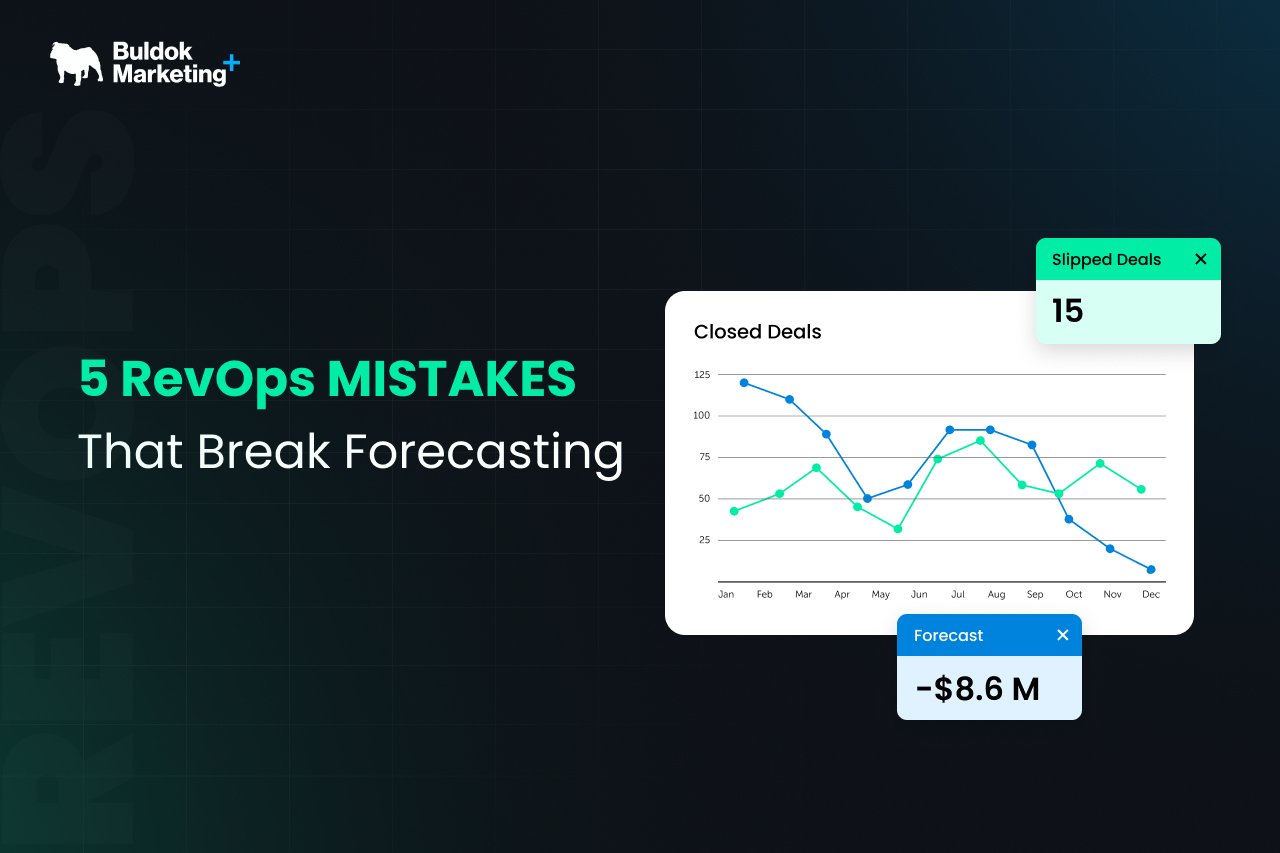
Revenue forecasting sits at the centre of modern revenue operations. It informs hiring decisions, marketing investments, pipeline planning, and executive strategy. When forecasts are accurate, leadership teams can plan with confidence. When forecasts are unreliable, organisations operate with uncertainty.
Many companies assume forecasting is a sales problem. In reality, it is a RevOps system problem. Forecast accuracy depends on how marketing, sales, and customer success data flows through the revenue stack. If the underlying systems, definitions, or processes are misaligned, forecasts quickly become unreliable.
This blog walks through five specific RevOps mistakes that consistently destroy forecast accuracy, and what to do about each one. If your team is working inside HubSpot, there is a practical fix for each mistake using the tools already at your disposal.
At Buldok Marketing, we work with B2B companies every day that are sitting on powerful HubSpot portals that are not producing reliable forecasts. Here is why, and how to fix it.
Mistake 1: Using Pipeline Volume as a Proxy for Pipeline Health
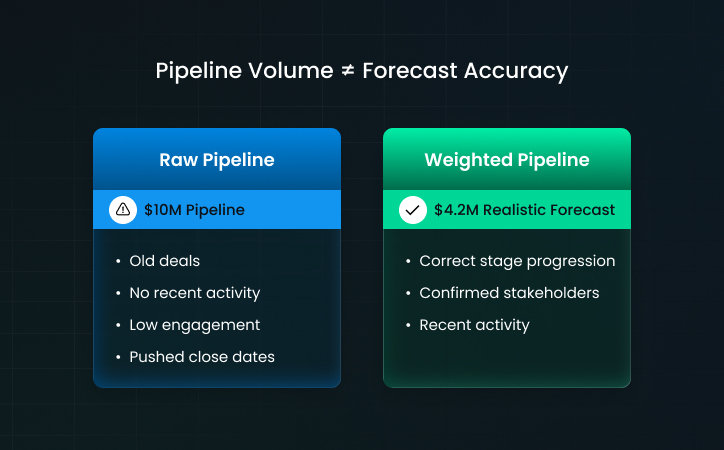
A full pipeline feels reassuring. It signals that the team is active, leads are coming in, and deals are moving. But volume alone tells you almost nothing about what will actually close.
The signals that actually predict close likelihood are things like stage velocity, how long a deal has been sitting in a stage without movement, engagement activity from the prospect, and how often the close date has been pushed back.
A deal that was created six months ago and has had its close date moved three times is not the same as a deal created last month with active email threads and a scheduled demo. But in a raw pipeline report, they look identical.
The HubSpot Fix
HubSpot's deal pipeline reports and built-in forecast tool let you filter by probability, close date, last activity date, and deal age.
Most teams never use these filters together. When you combine them, your inflated pipeline number deflates fast, and that is actually useful information.
Build a custom report in HubSpot that surfaces deals with stale close dates and no recent contact activity. Track the weighted pipeline value separately from the raw pipeline value. That distinction alone will make your forecasts more honest.
Mistake 2: No Standardised Deal Stages Across the Team
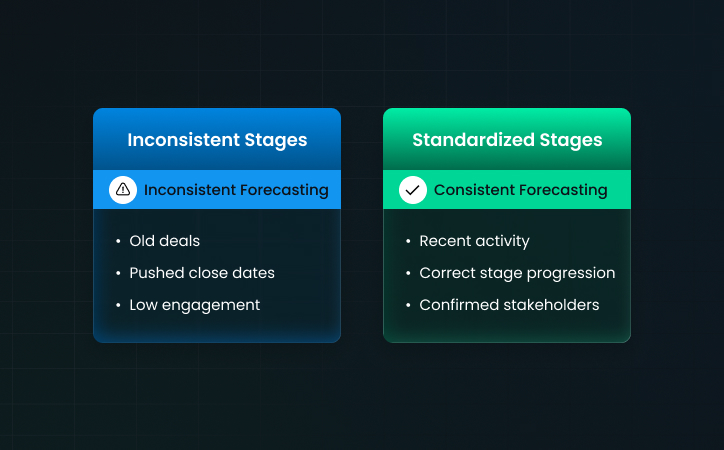
When each sales rep interprets stage definitions differently, the probability percentages attached to those stages become meaningless. If one rep moves a deal to Proposal Sent after a verbal conversation and another waits until a formal document is signed and sent, you cannot compare their pipelines. And you definitely cannot aggregate them into a reliable forecast.
Stage inconsistency also corrupts historical data. If you try to calculate average win rates by stage or average time-in-stage, you are calculating against a moving target. The data looks quantitative, but it is actually just a reflection of individual rep behaviour, not actual deal progression.
The HubSpot Fix
HubSpot's pipeline stages allow you to attach specific entry criteria, exit criteria, and probability percentages. You can use required properties and workflow automation to ensure reps cannot advance a deal to the next stage without completing key fields, such as a confirmed next step, a stakeholder identified, or a proposal date logged.
HubSpot's Sales Hub gives you the controls to make this operational, not just aspirational. Clear stage definitions are foundational to everything else in this list.
Mistake 3: Treating CRM Data Entry as Optional
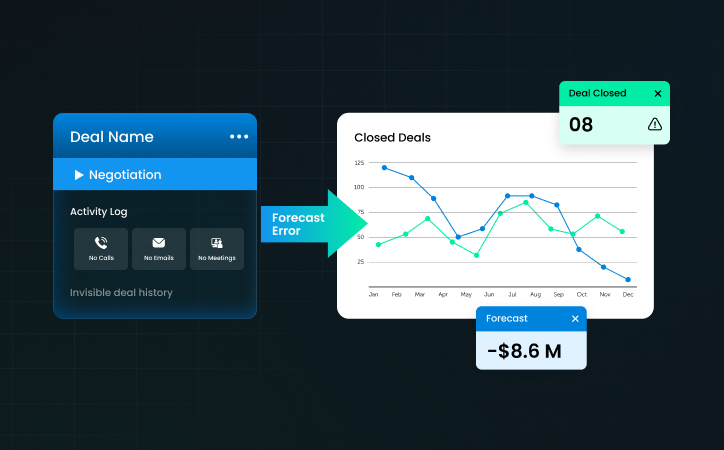
Forecasting models are only as reliable as the data behind them. When sales reps skip logging calls, forget to update deal properties, or never record meeting outcomes, the CRM becomes a partial picture. RevOps teams then fill those gaps with assumptions, and assumptions compound into forecast drift.
The result is a HubSpot portal full of deals that have moved stages without a single logged activity. There is no call record. No email. No meeting. Just a deal that appeared in one stage and somehow ended up in another. You cannot forecast from that.
The HubSpot Fix
HubSpot's activity logging through Gmail and Outlook integration, call logging, and meeting scheduling removes a significant amount of friction from data entry. But the process still needs to be reinforced structurally.
Use workflow alerts to flag deals that have been inactive for more than a set number of days. Make key properties required before stage advancement. Build dashboards that show rep-level activity so managers can coach proactively, not reactively.
When reps see that activity data directly influences their pipeline view and their coaching conversations, compliance improves. The HubSpot CRM is built to reduce friction here, but it requires a strategised setup to work this way.
Mistake 4: Forecasting From the Wrong Time Horizon
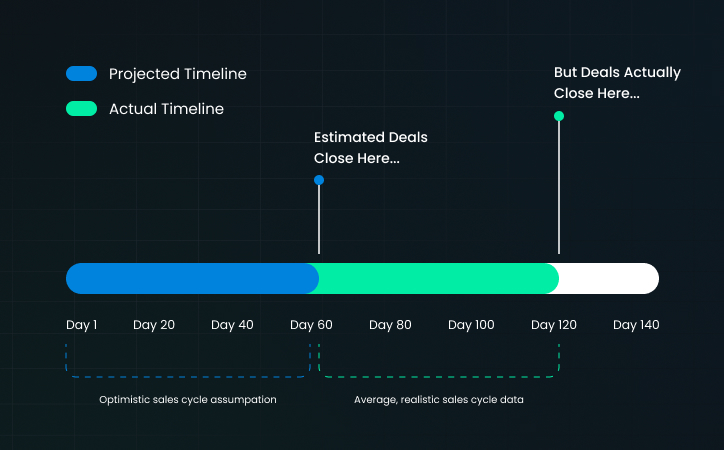
Most RevOps teams build forecasts by looking at what is currently in the pipeline. That is a reasonable starting point, but it creates a structural blind spot. Deals that will close in 60 to 90 days are often not in the pipeline yet. If you only report on the existing pipeline, you are always forecasting from incomplete data.
A forecast built entirely on current snapshot data cannot account for new deals that will enter and close within the forecast window, or for the historical reality that a certain percentage of the pipeline always slips out of the quarter.
The HubSpot Fix
HubSpot's reporting lets you track pipeline coverage ratio and new deal creation rate over time. Combine this with your historical average sales cycle length by stage and your historical win rates, and you can build a rolling forecast model that projects forward rather than just summarizing backward.
This kind of predictive view is possible inside HubSpot using custom reports and saved dashboard filters. If you want to go deeper on the metrics that make this work, our post on 5 Overlooked Metrics Every RevOps Leader Should Track covers the specific KPIs worth building into this model.
Mistake 5: Marketing and Sales Operating on Separate Data Sets
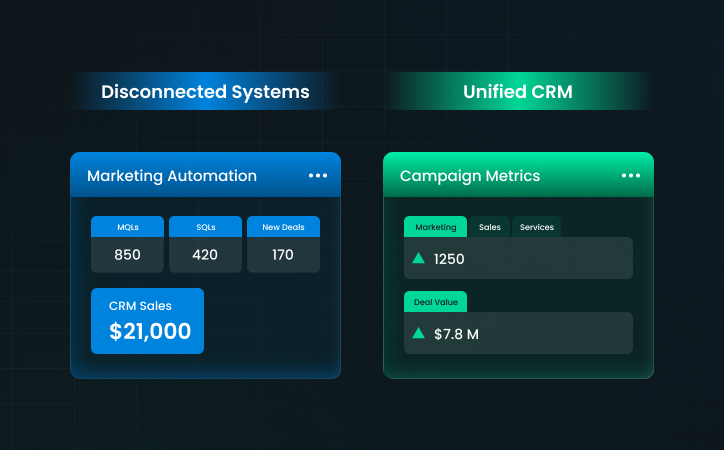
RevOps exists to unify revenue data across marketing, sales, and customer success. But in practice, many teams still run marketing attribution in one tool, pipeline reports in another, and try to reconcile them manually at the end of the month. The result is that forecasting happens in a data silo, and the full revenue picture is always one step out of reach.
When marketing and sales operate from different data sets, revenue forecasting becomes a negotiation between two versions of reality. Marketing says a campaign generated 40 qualified leads. Sales says only 5 of them were worth touching. Neither team is wrong, but without a shared data foundation, neither can make the other's case or course-correct intelligently.
The HubSpot Fix
HubSpot's unified CRM connects marketing touchpoints directly with sales outcomes. The attribution reports in Marketing Hub link campaign performance to closed revenue, so forecasting can account for marketing-sourced pipeline quality, not just volume.
The first step is defining shared definitions for MQL, SQL, and pipeline stages that both teams agree on and track in the same system. From there, build a shared revenue dashboard in HubSpot that pulls from both Marketing Hub and Sales Hub data. When both teams are working from the same numbers, the forecast conversation changes from defensive to collaborative.
How to Overcome These Mistakes Before They Cost You Another Quarter
Reading through five separate mistakes can make this feel like five separate projects, but it’s not. These issues are interconnected, and fixing them in the right sequence creates a compounding effect where each improvement makes the next one faster to implement and more impactful.
1. Start with a Data Audit
Before changing any process, you need to know where the current data breaks down. Pull a HubSpot pipeline report filtered by last activity date, close date accuracy, and stage age. That single report will immediately surface problems from Mistakes 1, 2, and 3.
You will see deals that are months old with no activity, close dates that have never been updated, and stages that have not moved in weeks. That audit gives you a prioritised starting point rather than a list of abstract improvements.
2. Standardise Before You Automate
Fixing your stage definitions and entry criteria has to happen before you build any automations or forecasting workflows. Automating a broken process does not fix it. It just makes errors happen faster and at higher volume. Get your pipeline stages documented, agreed upon, and enforced with required fields first. Everything else builds on that foundation.
3. Build the Right Dashboards
Once your data is cleaner, create a shared HubSpot dashboard that covers weighted pipeline, pipeline creation rate, marketing-sourced deal value, and stage velocity. This directly addresses Mistakes 4 and 5 simultaneously.
A shared dashboard also removes the end-of-month data reconciliation problem because both teams are looking at the same live numbers throughout the month.
4. Make It a Recurring Habit, Not a One-Time Project
Forecasting accuracy degrades over time without active governance. Reps get busy, stage discipline slips, and the CRM gradually drifts back toward the data quality problems you just fixed. Set a monthly RevOps review cadence using HubSpot's saved reports and scheduled dashboard emails. Use that cadence to catch drift early rather than discovering it when the forecast misses.
If you want a structural framework for ongoing optimisation, Buldok Marketing’s HubSpot 360° services are designed exactly for this. It provides continuous improvement, strategic oversight, and the accountability structure that keeps revenue operations performing at their best beyond the initial implementation.
Forecasting Is a Discipline, Not a Dashboard
Every one of these five mistakes is fixable. None of them requires new tools, additional headcount, or a complete process overhaul. They require intentionality about how data is collected, how pipeline stages are defined, how teams share information, and how far forward you are looking when you build a forecast.
Forecasting accuracy is a direct reflection of RevOps discipline. The CRM is only as smart as the process behind it. When the process is clean, HubSpot's forecasting and reporting capabilities can do exactly what they are built to do: give you a clear, reliable view of what revenue is coming and when.
If your HubSpot portal is collecting data but not producing forecasts you can trust, that is a signal your revenue infrastructure needs attention. Buldok Marketing works with B2B companies as a HubSpot Platinum Partner to build the kind of revenue operations foundation that makes forecasting predictable.
If that sounds like the conversation your team needs, book a 30-min consultation and let's look at where the gaps are.