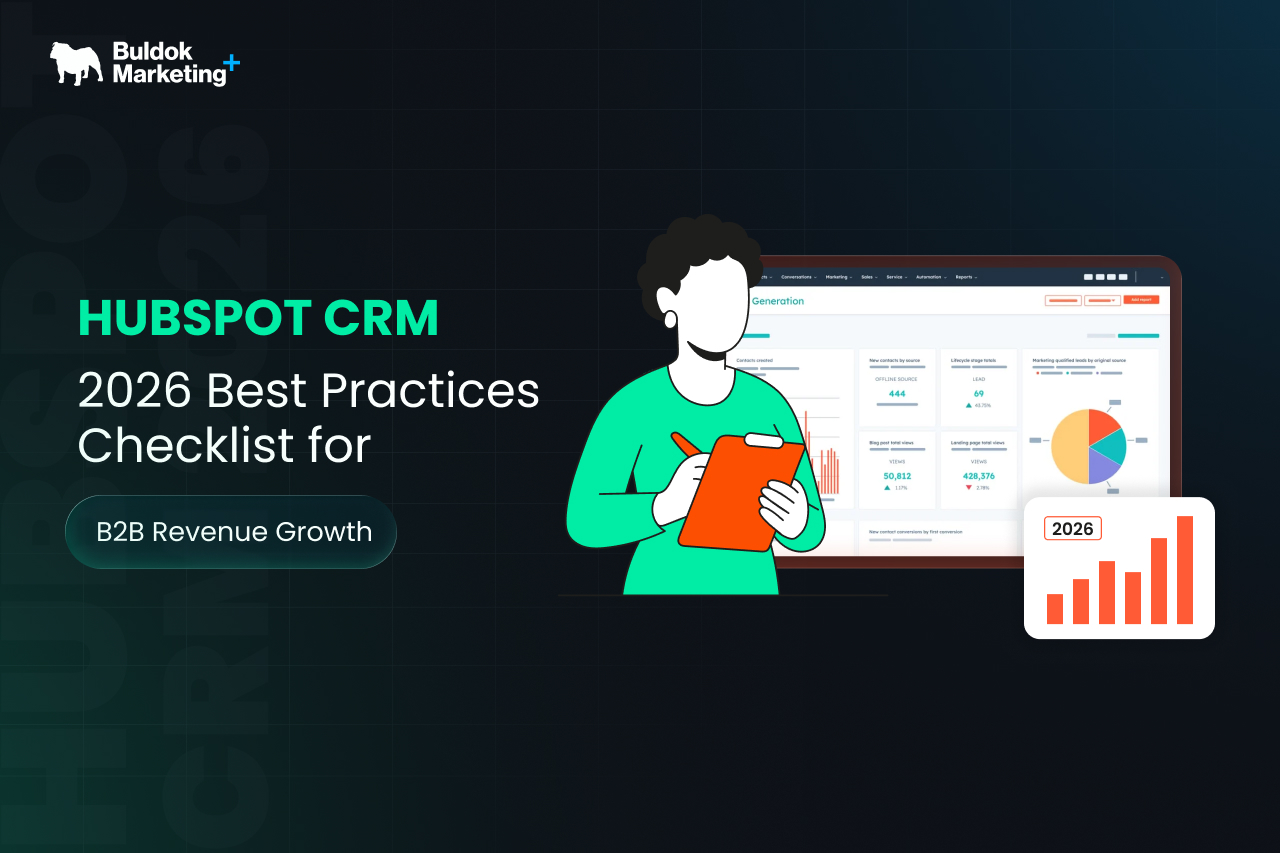
B2B revenue growth in 2026 will not come from adding more tools. It will come from using your CRM the right way.
Many B2B teams are running HubSpot, but only a few are using it as a true revenue engine.
Pipelines exist, but forecasting is unreliable. Workflows are built, but lifecycle stages are messy. Marketing generates leads, but sales does not trust the data. Leadership wants predictable growth, but reporting feels reactive.
If that sounds familiar, this blog is for you.
This is not a feature walkthrough. It is a strategic checklist designed for B2B teams that want measurable revenue growth, not CRM complexity. It reflects how modern RevOps teams structure HubSpot in 2026: AI-supported, data-governed, sales-aligned, and revenue-focused.
Let’s go step by step.
9 HubSpot CRM Best Practices For Better Revenue Growth
1. Revenue Architecture Comes First, Not Automation
Before optimising workflows or building dashboards, your revenue architecture must be clean.
In 2026, CRM success starts with structural clarity:
- Clearly defined lifecycle stages
- Mutually agreed lead qualification criteria
- Standardised deal stages with exit criteria
- Documented ownership rules
- Revenue source tracking that leadership trusts
Too many teams build automation on top of confusion. That only scales the inconsistency.
A high-performing HubSpot CRM should answer:
- Where exactly does a contact sit in the buying journey?
- What qualifies a contact to become an opportunity?
- What moves a deal from stage to stage?
- Who owns the next action?
If those answers are inconsistent across teams, automation will amplify misalignment.
At Buldok Marketing, we often see growth unlock after clarifying revenue architecture before touching a single workflow. Strong RevOps starts with structure.
If you are exploring strategic CRM alignment, this is where our Revenue Operations expertise comes into play.
2. Lifecycle Stages Must Reflect Buying Reality
Lifecycle stages in 2026 cannot be generic.
Subscriber > Lead > MQL > SQL > Opportunity > Customer is not enough.
Modern B2B buying is nonlinear. Your CRM must reflect:
- Multi-touch journeys
- Buying committees
- Re-engagement cycles
- Long evaluation windows
- Expansion and upsell motions
Best practice checklist:
- Define MQL based on behaviour and fit, not just form fills
- Align SQL definition with sales leadership
- Track buying roles inside companies
- Separate new business vs expansion lifecycle paths
- Create clear reactivation logic
If lifecycle logic is unclear, revenue reporting becomes unreliable.
HubSpot CRM supports advanced lifecycle automation, but it requires intentional design. This is where many teams need structured CRM implementation and strategic oversight, not just tool configuration.
3. Pipeline Design Must Drive Forecast Accuracy
Forecasting problems are rarely related to forecasting; they are pipeline discipline problems.
In 2026, B2B revenue leaders expect:
- Stage-level conversion tracking
- Average sales cycle visibility
- Deal velocity reporting
- Accurate weighted forecasting
- Clear stalled-deal indicators
Best practice checklist:
- Every stage has entry and exit criteria
- Close dates are mandatory and monitored
- Probability is not manually manipulated
- Stalled deals trigger workflow alerts
- Sales managers review pipeline hygiene weekly
A well-designed HubSpot pipeline becomes your single source of revenue truth. Without it, dashboards are cosmetic.
For teams scaling across markets or regions, CRM optimisation becomes critical to maintaining forecast integrity.
4. AI Should Support Sales, Not Replace Process
AI inside HubSpot is powerful. But it only works on clean data. In 2026, best-in-class teams use AI for:
- Predictive lead scoring
- Deal risk identification
- Email personalisation suggestions
- Content recommendations
- Sales activity prioritisation
However:
AI cannot fix unclear lifecycle stages, repair inconsistent deal updates, or compensate for poor CRM hygiene.
Best practice checklist:
- Clean and standardised property structure
- Automated data enrichment
- Activity tracking connected to revenue reporting
- AI scoring aligned to defined ICP criteria
- Human oversight in forecasting decisions
AI amplifies clarity. It also amplifies chaos. The difference lies in governance.
5. Marketing and Sales Alignment Must Be Operational, Not Verbal
Alignment is not a quarterly meeting. It is a system design choice.
HubSpot CRM should operationalise alignment by:
- Shared dashboards
- Closed-loop reporting
- Attribution visibility
- SLA tracking
- Feedback workflows
Best practice checklist:
- Marketing sees pipeline contribution, not just MQL volume
- Sales sees campaign engagement context
- Leadership sees full funnel conversion rates
- SLA breaches are automatically flagged
- Revenue reporting is centralised
If marketing and sales operate from different data perspectives, revenue friction becomes inevitable.
This is where a structured RevOps strategy creates measurable impact, particularly in B2B SaaS and complex sales environments.
6. Reporting Must Be Executive-Ready
Your CEO should not need five exports to understand revenue health.
In 2026, CRM dashboards must answer:
- Are we hitting pipeline targets?
- Where is conversion leaking?
- What is forecast reliability?
- Which channels drive real revenue?
- How does CAC compare to LTV?
Best practice checklist:
- Standardised KPI dashboard for leadership
- Funnel conversion tracking by segment
- Revenue source reporting beyond last-touch
- Cohort analysis visibility
- Clear segmentation by ICP
HubSpot reporting capabilities are strong, but most teams underutilise them. CRM should be your revenue command centre, not a reporting afterthought.
7. CRM Governance Is the Hidden Growth Lever
Governance is rarely exciting; it is always necessary. In 2026, high-performing B2B teams implement:
- Property documentation standards
- Change management procedures
- Regular data audits
- Permission control frameworks
- Quarterly CRM health reviews
Best practice checklist:
- No duplicate or unused properties
- Clear naming conventions
- Controlled workflow creation
- Periodic pipeline review sessions
- CRM ownership is defined at the executive level
Without governance, CRM complexity grows silently. Eventually, trust declines. And once trust declines, adoption follows. Revenue growth depends on CRM credibility.
8. Integration Strategy Determines Scalability
HubSpot rarely operates alone. In B2B environments, it integrates with:
- ERP systems
- Billing platforms
- Product analytics tools
- Customer success software
- Marketing automation layers
Best practice checklist:
- Clear system of record defined
- Bi-directional sync where necessary
- Duplicate data prevention logic
- Integration performance monitoring
- RevOps oversight of tech stack
Uncontrolled integrations create reporting inconsistencies. Scalable revenue operations require intentional system architecture, not just connected tools.
9. Customer Expansion Must Be Built Into CRM Logic
Revenue growth in 2026 is not only about acquisition. It is about expansion. HubSpot CRM should support:
- Cross-sell pipelines
- Renewal tracking
- Customer health scoring
- Account-based marketing workflows
- Revenue attribution for upsell campaigns
Best practice checklist:
- Separate pipeline for expansion deals
- Clear renewal reminders
- Account engagement tracking
- Customer marketing reporting
- Success team CRM visibility
Retention and expansion are revenue multipliers. If your CRM only tracks new business, you are underutilising it.
The 2026 HubSpot CRM Revenue Growth Checklist
Let’s summarise the essentials that you should keep in mind while using HubSpot for Revenue Growth:
- Revenue architecture clarity
- Accurate lifecycle logic
- Forecast-ready pipeline design
- AI supported by clean data
- Operational sales-marketing alignment
- Executive-level reporting dashboards
- Governance and data discipline
- Intentional integration strategy
- Built-in expansion workflows
This is not about more automation; it is about smarter structure.
Final Thought: CRM Is a Revenue System, Not a Database
In 2026, B2B growth belongs to companies that treat CRM as infrastructure, not software. HubSpot CRM can absolutely support scalable revenue growth. But only when strategy guides configuration, governance protects clarity, alignment is operationalised, and reporting drives decisions.
At Buldok Marketing, we work with B2B teams that want predictable revenue, cleaner reporting, and CRM systems that leadership trusts.
If your HubSpot instance feels busy but not strategic, it may be time to rethink the structure behind it. Because revenue growth in 2026 will not reward complexity, it will reward clarity.