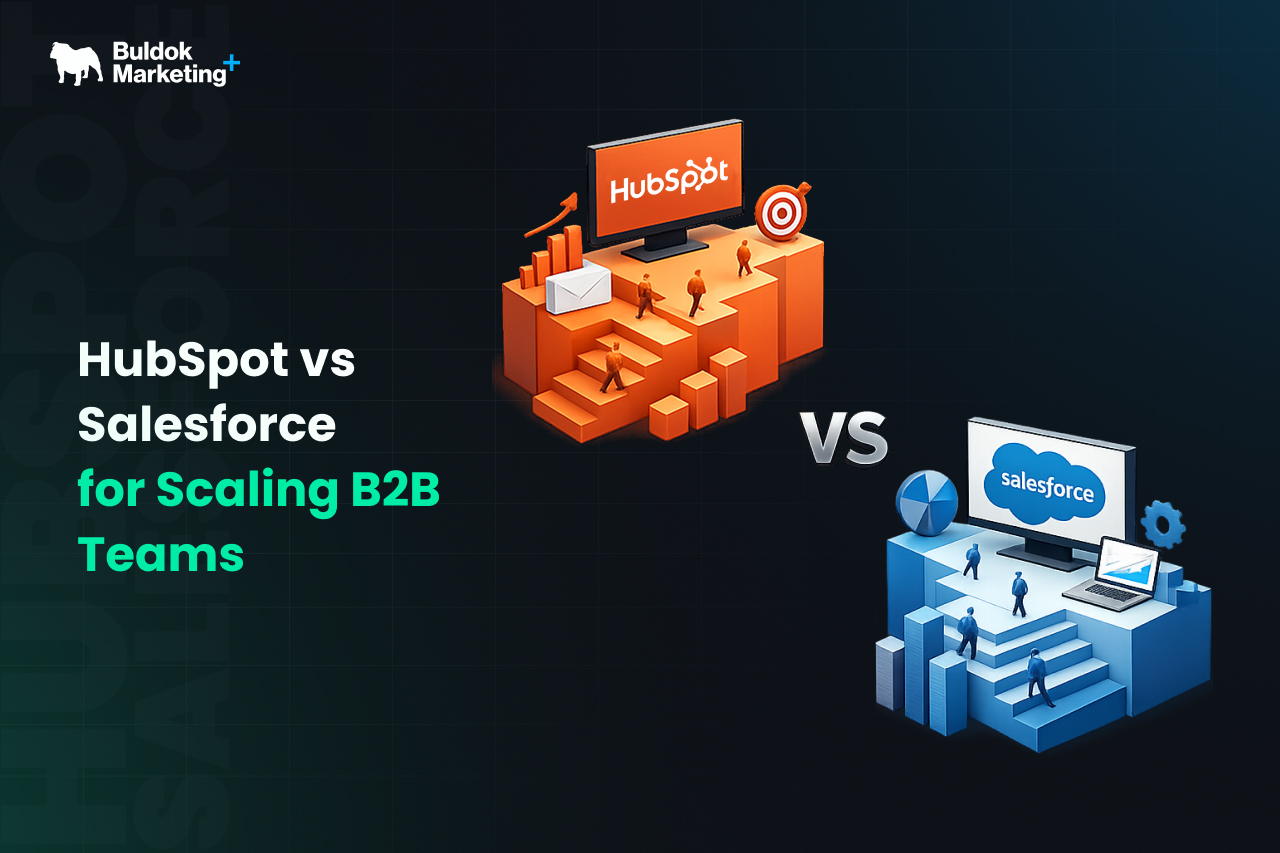
Different B2B teams have different scaling goals, and when it comes to choosing the right CRM from HubSpot vs Salesforce, the decision impacts operational structure, reporting visibility, marketing scalability, sales alignment, and long-term revenue execution.
Pricing note (October 2026): new HubSpot customers in Europe, the Middle East, and Africa now buy HubSpot on seats-and-credits pricing, so license math differs from the per-Hub figures below. See our HubSpot pricing guide for current EUR prices.
Get it right, and your teams run in sync. Get it wrong, and you spend years fighting your own systems instead of growing revenue.
Both HubSpot and Salesforce have earned their reputations and can handle complex B2B customer relationship operations. But they are fundamentally built differently, serve different team profiles, and carry very different cost structures over time.
If you are evaluating one of them for a scaling B2B team, the question is not which platform is "better." The question is which one is better for your stage, your team, and your growth model.
This blog breaks down the comparison across the dimensions that actually matter for B2B teams in motion.
In short, the practical difference comes down to three axes: total cost of ownership (licensing plus implementation plus ongoing admin), the administrative overhead required to keep the system running day to day, and time-to-value from signed contract to a team actually adopting the platform. HubSpot generally wins on the second and third; Salesforce trades that speed for depth once requirements get genuinely complex.
The CRM Market Reality in 2026
Before getting into features and pricing, it helps to understand where each platform stands today.
HubSpot ended 2025 with 288,706 paying customers across more than 135 countries, growing roughly 25% year over year and adding approximately 60,000 customers in 2025 alone. That growth reflects a meaningful shift in how mid-market B2B companies think about their go-to-market stack.
Salesforce, for its part, remains the market leader by revenue share. Salesforce commands a 20.7% global CRM market share according to IDC, while posting $41.5 billion in fiscal 2026 revenue. It is the dominant platform for large enterprise organizations with complex workflows, multi-region operations, and dedicated technical teams.
The practical insight here is straightforward: both platforms are growing. But they are growing in different directions and attracting different kinds of teams.
The Real CRM Selection Challenge for Scaling B2B Firms
Early-stage companies often select a CRM based on affordability or ease of setup. But scaling teams face very different operational realities.
As revenue grows, companies typically encounter problems like:
- Disconnected marketing and sales reporting
- Inconsistent lead qualification processes
- Data fragmentation across departments
- Poor forecasting visibility
- Complex account ownership structures
- Manual pipeline management
- Multi-region sales coordination
- Difficulty maintaining CRM adoption
At this stage, the CRM becomes the operational foundation of the revenue engine.
This is why CRM scalability is not only about handling more contacts or larger databases. It is about supporting increasingly complex workflows without slowing teams down.
For many growing B2B companies, this is where HubSpot and Salesforce begin to separate.
What Sets These Platforms Apart at the Core
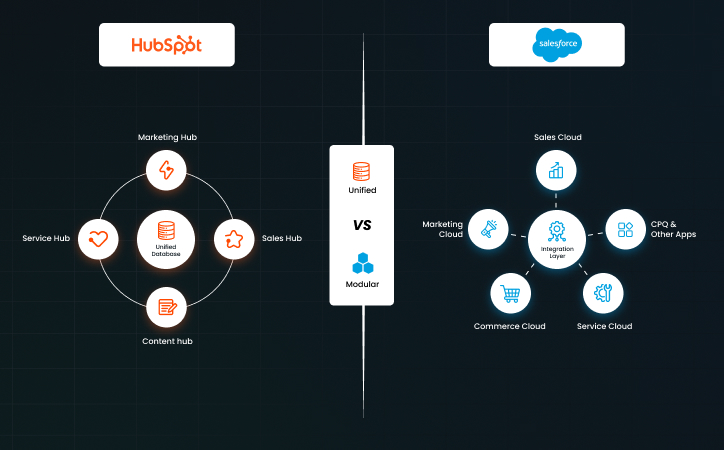
HubSpot was built as an inbound marketing tool in 2006 and grew into a full CRM platform. Everything, from marketing contacts to CRM records to service tickets, lives on a single shared database. There are no sync issues between marketing and sales because there is nothing to sync. The data is already unified.
Salesforce was built from the ground up as a CRM in 1999, with enterprise customization at its core. It operates on a modular "Clouds" model, where Sales Cloud, Marketing Cloud, and Service Cloud are separate products that need to be licensed, configured, and in many cases integrated with each other. This approach gives organizations flexibility, and also complexity that scales with the number of Clouds you add.
For B2B teams scaling from 20 to 200 people, this architectural difference has real consequences. HubSpot's unified model means your marketing team and your sales team are looking at the same contact record, the same history, and the same pipeline. HubSpot's structural advantage for content-led B2B companies is a single
native database for marketing contacts and CRM pipeline, eliminating the attribution gap that plagues multi-tool stacks.
Salesforce's modular approach becomes its strength when your organization has genuinely complex requirements: territory hierarchies, granular permission structures, CPQ (configure-price-quote) workflows, or industry-specific compliance mandates. For those use cases, its depth is unmatched.
HubSpot Vs Salesforce: Strength Comparison
HubSpot’s Strength
For scaling B2B companies, a CRM only creates value when teams actively use it. If the system feels complex to use, it often leads to inconsistent data entry, fragmented reporting, and workflow breakdowns.
HubSpot reduces much of this friction through a unified platform structure where marketing, sales, service, CMS, and automation tools operate within the same ecosystem.
Here are the primary factors that make HubSpot a good choice for scaling businesses:
- Faster Team Adoption
Sales and marketing teams typically learn HubSpot faster than Salesforce. The interface is easier to navigate, workflows are more accessible, and reporting can often be configured without deep technical expertise.
- Better Marketing and Sales Alignment
HubSpot’s architecture keeps campaign attribution, lead scoring, lifecycle stages, and sales activity tightly integrated. This becomes valuable for B2B organizations focused on inbound growth, content-driven demand generation, and revenue attribution.
- Lower Administrative Complexity
Salesforce often requires dedicated administrators and developers as complexity increases. HubSpot reduces this dependency for many mid-market organizations. Internal teams can manage workflows, dashboards, automations, and reporting with significantly less technical overhead.
If HubSpot seems like your CRM choice, hire an expert HubSpot partner who can help you with everything from HubSpot implementation to complete platform management and support.
Salesforce’s Strength
Salesforce dominates the enterprise CRM market for a reason: The platform is designed for organizations with highly customized workflows, large operational structures, global sales organizations, and advanced integration requirements.
For enterprise B2B companies operating across multiple business units, Salesforce provides flexibility that HubSpot may not fully replicate.
Here are the primary factors that make Salesforce a good choice for scaling businesses:
- Ease of Scaling: Where the Difference Becomes Clear
The most important distinction between HubSpot and Salesforce is how each platform approaches scaling. HubSpot focuses on scaling simplicity. Salesforce focuses on scaling customization. That difference shapes nearly every operational experience inside the platform.
It becomes more valuable when organizations require:
- Highly customized workflows
- Extensive enterprise integrations
- Multi-region governance
- Complex sales structures
- Large-scale security controls
- Advanced development environments
- Industry-specific operational customization
The platform is built for operational depth rather than simplicity. For some companies, that investment is justified. For others, it creates unnecessary operational friction.
After comparing the strengths, let’s move forward with the common factors that affect the decision of HubSpot vs Salesforce: which one to choose for scaling B2B teams.
Factor 1# Implementation Timeline & Cost
Pricing tables are rarely the full story. The real cost of a CRM includes implementation, ongoing administration, training, and the hidden fees that surface after you have already committed.
For a 25-person team, HubSpot Professional costs approximately $20,400 per year versus approximately $49,500 per year for Salesforce Enterprise, a $29,000+ annual gap that widens at scale. But the licensing gap is only part of the picture.
The implementation timeline is also another factor of consideration here. HubSpot wins on ease of use, with fast setup, an intuitive interface, and self-service management that your team will actually adopt. Salesforce is more powerful but steeper to learn, with most organizations expecting 3 to 6 months and $30,000 to $100,000 just to go live.
Depending on the budget, timeline constraints, and other requirements, you can choose a suitable CRM for your organization. If cost is the deciding factor, our related breakdown of whether HubSpot is worth it for mid-market companies looks at the ROI math in more depth.
Factor 2# The AI Question: Breeze vs Agentforce
Both platforms have made significant AI investments, and both have released agent-based tools that can automate tasks across the sales and marketing workflow.
Salesforce launched Agentforce, its autonomous AI agent framework designed to execute multi-step tasks across the entire Salesforce data ecosystem. It is powerful, but it reflects the broader Salesforce architecture: deep capability that requires significant setup and a technical team to configure properly.
HubSpot responded with Breeze AI, which includes tools like Breeze Copilot for sales reps, a Prospecting Agent for automated outreach, and a Customer Agent for support. HubSpot's Breeze activates in an average of 36 days, and its Customer Agent uses 50 HubSpot Credits (about $0.50) per resolved conversation, making it accessible for non-technical users without an AI architect on staff.
Agentforce is more powerful than Breeze at enterprise scale, but it requires months of setup. For a scaling B2B team without a dedicated tech team, it is overkill. They need practical AI capabilities that help marketing and sales teams move faster within daily workflows.
This is one reason HubSpot continues gaining traction among modern revenue teams.
Factor 3# Reporting and Revenue Visibility
Both platforms provide advanced reporting capabilities, but the operational experience differs significantly.
Salesforce offers extremely powerful reporting environments, especially when combined with Tableau and enterprise analytics infrastructure. But those environments often require specialized configuration and maintenance.
On the other hand, HubSpot prioritizes reporting accessibility. Marketing, sales, and service dashboards are easier to build, modify, and operationalize without deep technical expertise.
For fast-growing B2B organizations, this often creates faster decision-making cycles because teams spend less time managing reporting infrastructure.
Businesses implementing structured CRM onboarding strategies through partners such as HubSpot Onboarding with Buldok Marketing often see stronger adoption because reporting, automation, and process alignment are configured together from the beginning.
So, Where Each Platform Wins for B2B Teams
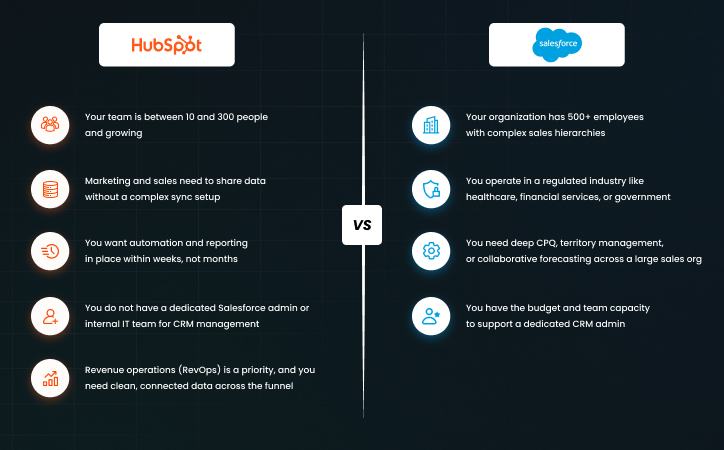
The honest answer to "which platform is better for B2B?" is that it depends on your complexity and your team's capacity to manage it. But there are clear patterns across real-world deployments.
HubSpot tends to perform best when:
- Your team is between 10 and 300 people and growing
- Marketing and sales need to share data without a complex sync setup
- You want automation and reporting in place within weeks, not months
- You do not have a dedicated Salesforce admin or internal IT team for CRM management
- Revenue operations (RevOps) is a priority, and you need clean, connected data across the funnel
Salesforce tends to perform best when:
- Your organization has 500+ employees with complex sales hierarchies
- You operate in a regulated industry like healthcare, financial services, or government, where FedRAMP authorization or HIPAA-eligible environments are non-negotiable
- You need deep CPQ, territory management, or collaborative forecasting across a large sales org
- You have the budget and team capacity to support a dedicated CRM admin
For marketing-led B2B companies, HubSpot Professional's unified Marketing and Sales Hubs on a single database eliminate the data sync headaches of running separate marketing automation and CRM platforms. That is a meaningful advantage for teams where content, inbound leads, and pipeline attribution are central to the growth model.
HubSpot vs Salesforce: Making the Decision for Your Team
The honest framework for this decision comes down to five questions:
- How large is your team today, and how complex is your sales process?
- Do you have a dedicated CRM admin or the budget to hire one?
- Is marketing-sales alignment a current pain point, or are your teams already well-coordinated?
- Does your industry require specific regulatory compliance features?
- How quickly do you need the system to be operational and adopted?
You can choose HubSpot:
If your answers point toward a mid-market B2B team with a content-driven inbound model, a growing sales team, and a need for fast time-to-value, HubSpot is almost certainly the right platform.
You can choose Salesforce:
If your answers point toward a 500-person organization with territory hierarchies, complex approval workflows, and industry-specific compliance requirements, Salesforce earns its premium.
The good news is that both platforms have matured significantly. You are not choosing between a starter tool and an enterprise tool. You are choosing between two enterprise-capable platforms with different philosophies about how that capability should be delivered.
Final Thoughts: Getting the Implementation Right
The platform choice is only half the equation. How you implement it determines whether it becomes the system your team relies on every day or another piece of software gathering dust in a browser tab.
This is exactly the problem that Buldok Marketing addresses for B2B companies across European markets. As a HubSpot Platinum Partner, our work is not just about configuring a portal; it is about building revenue infrastructure: clean data, connected automations, trained teams, and dashboards that actually tell you something useful.
For teams that want to understand what good HubSpot execution looks like before committing to a direction, the HubSpot CRM 2026 Best Practices Checklist for B2B Revenue Growth is a practical starting point.
The right CRM choice, paired with a thoughtful implementation, is one of the highest-leverage decisions a scaling B2B team can make. It is worth getting both parts right.
Frequently asked questions
Is HubSpot cheaper than Salesforce?
For most mid-market teams, yes, on a total cost of ownership basis. As outlined above, HubSpot Professional runs meaningfully less than Salesforce Enterprise per year for a comparable team size, and Salesforce implementations typically add tens of thousands of dollars in setup costs that HubSpot's faster, more self-service onboarding avoids. The gap narrows if you need Salesforce's higher-tier editions or heavy customization work.
Can HubSpot handle enterprise complexity?
Yes, for many enterprise use cases, though not all. HubSpot supports large contact volumes, multiple business units, and advanced permissioning, and companies well beyond 300 employees run on it successfully. Where Salesforce still pulls ahead is in scenarios with deep CPQ requirements, complex territory hierarchies, or regulated environments where FedRAMP or HIPAA-eligible infrastructure is non-negotiable.
How hard is migrating from Salesforce to HubSpot?
Migration difficulty depends mostly on how customized your Salesforce instance is and how much historical data and automation logic needs to carry over. Straightforward CRM data migrations are routine, while migrations involving custom objects, complex workflow rules, or CPQ configurations require more careful planning. Working with an experienced HubSpot migration partner reduces the risk of data loss or broken reporting during the switch.