HubSpot releases a lot of product updates. In fact, the Fall 2026 Spotlight includes more than 100 updates across its CRM, AI, marketing, sales, service, revenue, and ecosystem products. Trying to keep track of every new feature would be a full-time job in itself.
Fortunately, most B2B teams do not need to.
The more useful question is: Which HubSpot Fall 2026 updates could actually change how marketing, sales, and RevOps teams work?
That is where this release gets interesting.
At Fall Spotlight, announced during UNBOUND 2026, HubSpot introduced a self-updating Smart CRM, Context Home, a rebuilt Breeze Assistant, Marketing Studio, major sales AI updates, and new advertising integrations. Underneath those individual launches is a bigger idea HubSpot calls Growth Context: giving AI a
working understanding of your business, customers, team, and processes so it can do more than generate generic content.
For B2B companies already using HubSpot, that shift matters more than the sheer number of new features.
Here are seven Fall 2026 updates worth paying attention to.
1. HubSpot's Smart CRM Is Starting to Update Itself
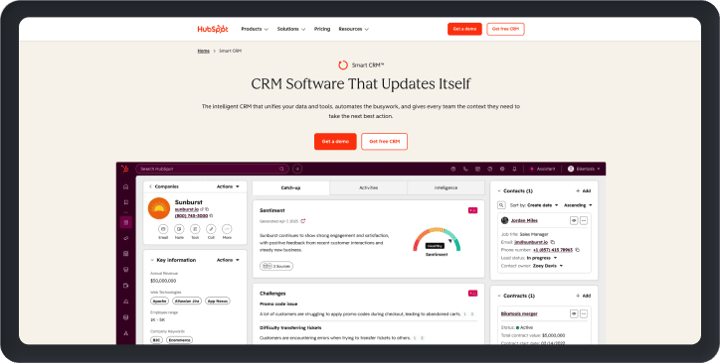
Anyone who has managed a CRM knows the problem: a CRM is supposed to contain the latest information about prospects, customers, deals, and conversations. But keeping it current often depends on people remembering to update its properties, write notes, log meetings, and change deal information after every interaction.
That does not always happen.
HubSpot's new self-updating Smart CRM is designed to reduce that dependency. The CRM can capture information from calls, emails, and meetings, and use those interactions to keep records current automatically.
Rather than treating CRM data as something employees need to manually maintain after the work happens, HubSpot is increasingly trying to make data capture part of the work itself.
What It Means for B2B Teams?
This matters because CRM quality affects almost everything downstream.
If your data is incomplete, your segments become unreliable. Workflows trigger at the wrong time. Sales forecasts become questionable. Reporting becomes harder to trust. And AI systems working from those records receive incomplete context.
Consider a sales rep who has a discovery call with a prospect.
The prospect mentions that implementation needs to happen in Q1, security is involved in the buying process, and another stakeholder needs to approve the project.
Traditionally, somebody needs to remember to put that information into the CRM. But today, HubSpot is taking it in a new direction:
Customer interaction → captured context → updated CRM → better next action
That does not mean B2B teams can stop caring about CRM governance. Properties, lifecycle definitions, pipeline rules, integrations, and data standards still need human ownership.
But the administrative burden of keeping individual records current could become much smaller.
2. Context Home Makes AI Context Something Teams Can Actually Manage
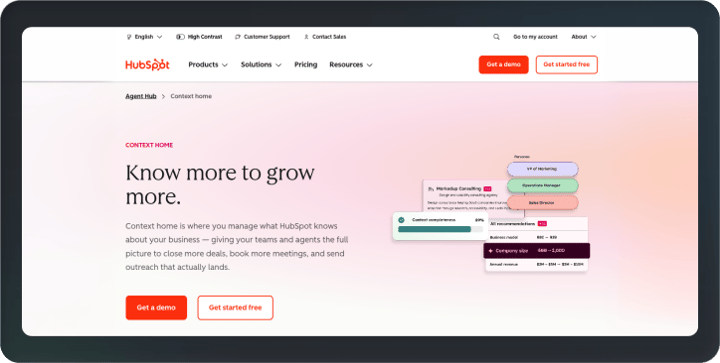
One of the more important Fall 2026 releases is also one of the easiest to overlook. It is called Context Home.
HubSpot's AI strategy increasingly revolves around Growth Context: the information AI needs to understand your business rather than simply access your data.
Context Home gives teams a central location to see what HubSpot understands about their company, customers, team, and processes. Teams can identify missing information, correct inaccurate context, and keep that understanding current as the business changes. HubSpot also provides a score indicating the completeness of that context foundation.
When AI starts performing operational tasks, context home helps it understand your business’s ICP, positioning, brand, processes, and how your team typically works.
It Brings In a New RevOps Responsibility
For years, RevOps teams have focused heavily on CRM architecture and data quality. AI could add another responsibility: ‘maintaining context quality’
If your CRM says one thing, your positioning documents say another, your ICP definition is outdated, and your internal processes have changed, an AI agent can still produce the wrong recommendation even when the underlying records are technically accurate.
This means teams implementing HubSpot AI should not ask only:
"Is our data clean?"
They may also need to ask:
"Does HubSpot understand enough about how our company actually operates to make good decisions?"
That is a much more interesting problem than simply adding another AI assistant to the CRM.
3. Breeze Assistant Is Moving From Answering Questions to Doing the Work
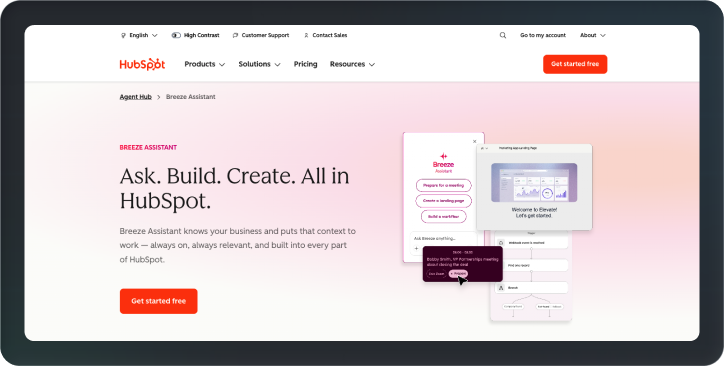
HubSpot has completely rebuilt Breeze Assistant for Fall 2026. HubSpot now positions it as a central interface through which teams can ask questions, create content, build assets, and coordinate specialized agents across the platform.
For example, a marketer could ask Breeze Assistant to help plan a campaign, draft nurture emails, or create a landing page.
But the larger change is that Breeze Assistant can call on specialized agents to complete different parts of the task.
This moves the interaction closer to:
Tell HubSpot what outcome you want → HubSpot coordinates the work
Rather than opening the tool and configuring features and assets manually.
What This Could Look Like in Practice
Imagine your marketing team notices that an important segment has generated leads but very few opportunities. Instead of manually moving between reporting, assets, CRM lists, etc., the marketer could simply start a conversation with the Breeze assistant like:
"Analyze why this segment is underperforming and help me create a nurture campaign for the leads that have not progressed."
Breeze Assistant can work with the CRM context and specialized agents to help turn that request into actual campaign work.
That is a more meaningful use of AI than generating another subject line.
The important qualification is that the output will only be as useful as the context behind it.
Giving AI more authority does not reduce the importance of good CRM structure, campaign strategy, positioning, or human judgment. It increases it.
4. Marketing Studio Brings Campaign Planning and Execution Closer Together
Marketing teams rarely struggle because they cannot produce another piece of content. They struggle with coordination.
Someone identifies an opportunity in analytics. Another person prepares the campaign brief. Content gets written elsewhere. The landing page gets built. Emails are created. Audiences are configured. Automation is added. Reporting follows later.
Every handoff creates friction.
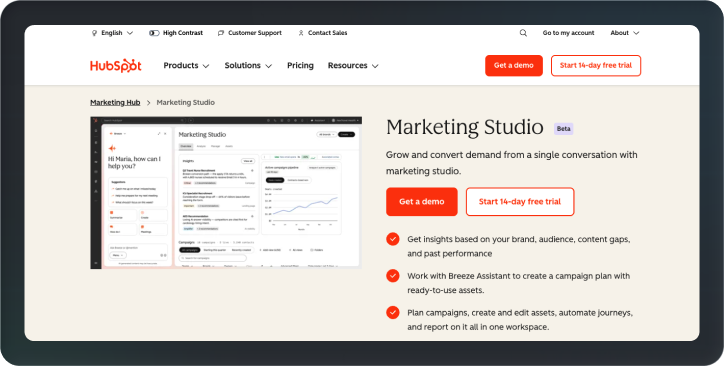
HubSpot's new Marketing Studio is an attempt to shorten that process.
Marketing Studio provides a shared workspace for building and nurturing demand. HubSpot says teams can start with actual insights, then use Breeze Assistant alongside specialized agents such as Campaign Agent and Content Agent to plan campaigns, create content, and build personalized nurture programs.
Why This Matters for B2B Marketing
B2B marketing tends to involve more context than a simple Ecommerce campaign.
You may be targeting different industries, personas, buying stages, account tiers, existing customers, active opportunities, or accounts showing a particular behavior. That information already exists in HubSpot for many companies.
Marketing Studio gives HubSpot a stronger opportunity to use that CRM context directly when campaigns are being built.
For example, instead of creating one generic nurture campaign for every lead, a team might create variations based on industry, previous engagement, lifecycle stage, or account characteristics.
But make sure to start small; do not rebuild your entire marketing operation around Marketing Studio on day one.
5. Prospecting Agent Is Getting Much Closer to an AI SDR
Finding accounts is rarely the hardest part of B2B prospecting; finding the accounts worth contacting is.
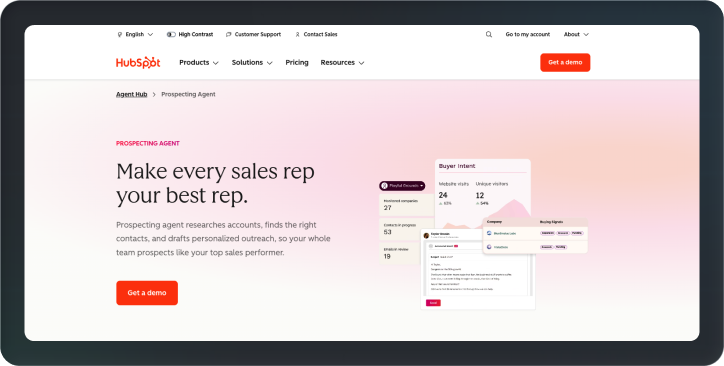
HubSpot's updated Prospecting Agent attempts to connect those steps.
According to HubSpot, Prospecting Agent can monitor more than 40 buying signals, score accounts against your ideal customer profile, source contacts, help assemble buying groups, and draft personalized outreach based on the available context.
That changes the potential role of AI in outbound sales.
Instead of merely helping a rep rewrite an email after the rep has already chosen an account and researched it manually, the agent can become involved much earlier in the process.
The workflow starts looking more like:
Signal → account qualification → buying group → research → outreach
But Automated Prospecting Can Automate Bad Prospecting Too
This is where B2B teams need some restraint.
If your ICP is vague, the agent has a vague standard for deciding which accounts matter.
If your CRM contains duplicates, poor segmentation, or outdated information, personalization becomes less trustworthy.
And if your positioning sounds like every competitor in the category, automatically generating more outreach will not fix the problem.
The value of Prospecting Agent therefore depends heavily on the work done before the agent begins prospecting.
RevOps and sales leaders should define:
- Who actually fits the ICP?
- What signals indicate real intent?
- Which personas normally influence the deal?
- What situations create a reason to buy?
- Where should human approval remain part of the process?
The goal should not be to maximize the amount of AI-generated outreach. It should be to help reps spend more time on accounts that deserve their attention.
6. Mobile Notetaker and Deal Progression Connects Meeting Intelligence to What Happens Next
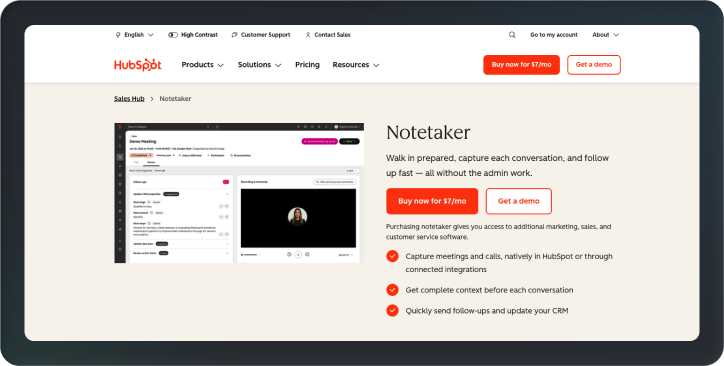
B2B companies have plenty of tools for recording meetings and producing transcripts. The transcript itself is no longer the impressive part. The harder problem is what happens after the meeting.
Was the deal updated? Did someone record the next step? Was a follow-up email sent? HubSpot's Fall 2026 sales updates try to connect those pieces.
Its new Mobile Notetaker can capture conversations in real time, including in-person meetings. HubSpot's revamped Deal Progression can then analyze conversation and deal information, recommend CRM updates, surface next actions, draft follow-ups, and keep deal plans current.
Why RevOps Teams Should Pay Attention
Pipeline visibility often breaks because CRM records reflect what the sales process looked like several days ago rather than what happened in the recent conversation.
A rep may know that the deal has stalled, but the forecast still looks healthy because that information has never reached HubSpot.
Connecting customer conversations more directly with deal records could reduce that gap. However, teams should still decide what AI is allowed to update automatically and where human approval is appropriate.
7. HubSpot Is Expanding Paid Demand Generation Into ChatGPT and Microsoft
Perhaps the most visible marketing change from Fall 2026 is about where B2B buyers are researching.
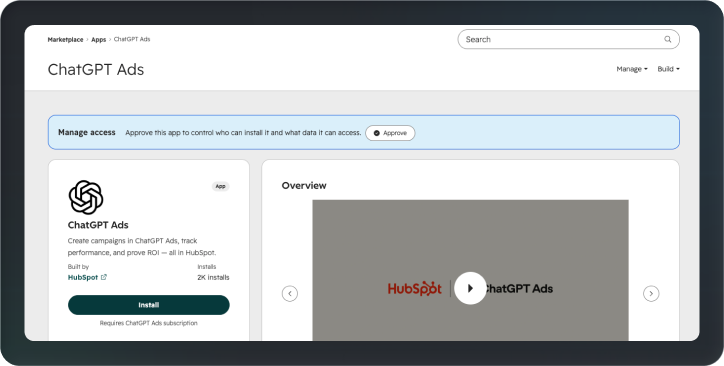
HubSpot has become the first CRM to integrate with ChatGPT Ads. The integration, currently available in public beta, allows marketers to create and manage ChatGPT ad campaigns, track performance, connect resulting contacts and deals to HubSpot, and compare that performance with other advertising channels.
The integration goes beyond reporting.
HubSpot can append tracking parameters to ChatGPT Ads URLs, automatically create CRM contacts from lead generation submissions, and use conversion events to send certain CRM outcomes back to ChatGPT Ads for optimization, subject to the required consent and configuration.
HubSpot has also added Microsoft Advertising, allowing teams to track campaign performance, contact attribution, and deal ROI within HubSpot alongside their other channels. Microsoft Advertising can reach audiences across surfaces including Bing, Copilot, MSN, and Outlook.
Why This Matters Beyond Another Ad Integration
B2B buyer research is fragmenting.
Google is still important, but buyers increasingly ask questions inside AI assistants, watch videos, read community discussions, compare vendors without immediately visiting their websites, and move across several digital environments before speaking with sales.
Marketing measurement therefore needs to move beyond:
Which channel generated the click?
and closer to:
Which combination of channels helped create and progress demand?
For B2B marketers, ChatGPT Ads are especially worth watching because they place paid visibility inside an environment where users are already asking questions, comparing approaches, and researching possible solutions.
It is too early to assume that ChatGPT Ads will outperform established B2B acquisition channels. The integration is still in beta.
But it is absolutely worth testing.
Not because every company suddenly needs a ChatGPT Ads budget, but because buyer behavior is changing faster than most attribution models.
What These HubSpot Updates Really Tell Us About Its AI Direction
Taken individually, the Fall 2026 updates can look like a collection of AI features. But look at them together and a clearer pattern appears.
HubSpot is building around a loop:
Context → AI → action → new context
- The Smart CRM keeps capturing information.
- Context Home helps manage what HubSpot understands.
- Breeze Assistant gives teams a conversational way to put that context to work.
- Specialized agents perform parts of the job.
- Marketing Studio coordinates campaign execution.
- Prospecting Agent acts on account and buying signals.
- Deal Progression turns conversations into CRM updates and next steps.
- Those actions then create more information for the CRM.
This is why the self-updating CRM may ultimately be more important than any individual AI feature.
AI becomes considerably more useful when the information it depends on improves continuously as people work.
Conclusion: HubSpot Is Becoming More Operational, Not Just More Intelligent
HubSpot Fall 2026 is not simply about adding more AI features to the platform. The bigger shift is how closely HubSpot is connecting CRM data, business context, AI agents, marketing execution, sales activity, and customer interactions.
For B2B teams, that creates both an opportunity and a responsibility.
The opportunity is to reduce repetitive work, improve CRM accuracy, respond to buyer signals faster, and move campaigns and deals forward with less manual coordination.
The responsibility is to make sure the foundation is strong enough for AI to work with. A clear ICP, reliable CRM data, accurate lifecycle stages, defined processes, and human oversight still matter. In fact, they matter even more when AI is involved in execution.
The smartest approach is not to adopt every Fall 2026 feature at once. Start with the areas where your team already experiences friction, test the relevant tools, and measure whether they actually improve the way your GTM team operates.
If you are evaluating how these HubSpot updates fit into your marketing, sales, or RevOps setup, Buldok Marketing can help you turn new HubSpot capabilities into practical processes that support your wider growth strategy.