Your company pays for ads, the website collects more form fills and marketing reports more leads than last year. A lead then lands with a salesperson, in an inbox or a spreadsheet. What happens next depends on who got it and how busy their week is.
Marketing sees leads. Sales sees deals.
Between them sits a part of the customer journey that nobody owns. Customer journey mapping is how you make that part visible. A map only works as a tool when each stage has an owner, a metric and data in a shared CRM. Otherwise it is just a document filed away after a workshop.
What customer journey mapping is
Customer journey mapping is the process of writing down every step a customer takes with your company, from first awareness through the purchase to whether they stay and buy again. The result, a customer journey map, shows who the customer is, what they go through, what they do at each step and where they get stuck.
It helps to keep the journey and the map apart. The journey is reality, and customers go through it whether or not anyone has drawn it. The map is your description of that reality. Like any description, it can be accurate, out of date or simply wrong.
One map covers one type of customer and one scenario. A map "for all customers" looks good on the wall, but you can't make decisions from it. A head of operations looking for a new supplier goes through a very different journey from a buyer who is placing a repeat order.
Marketing teams also talk about the funnel. A funnel measures how many people move from one stage to the next. A customer journey describes what customers experience along the way and who looks after them on your side. And unlike a classic funnel, the journey doesn't end when the contract is signed.
Why the journey matters even if nobody has written it down
Because your customers go through it anyway. Every company has a customer journey. It just often doesn't know what that journey looks like. The difference is whether you manage the journey or only notice how many people are missing at the end of it.
Companies often see their journey as better than customers actually experience it. In 2022 ActionIQ, a customer data platform vendor, surveyed more than 400 consumers and 350 businesses in the US and UK. In its US results from 2022, 61 % of businesses rated their customers as "very satisfied", while only 23 % of consumers felt the same. In a 2025 PwC survey in the US, about nine in ten executives said customer loyalty had grown, but only four in ten consumers agreed.
A customer who dislikes the journey doesn't have to complain. Often they just leave.
In the same 2025 PwC survey, 52 % of consumers had stopped buying from a brand after a bad product or service experience, and 29 % after poor customer experience. Both surveys cover US consumer markets, and B2B figures may differ. The principle probably holds for companies that sell to companies too.
Looking after the customer journey can also pay off. McKinsey wrote in 2026 that businesses leading in customer experience outperform their peers on growth and total shareholder returns, often by as much as two times.
Customer journey stages: how many there are and why the number matters less than you think
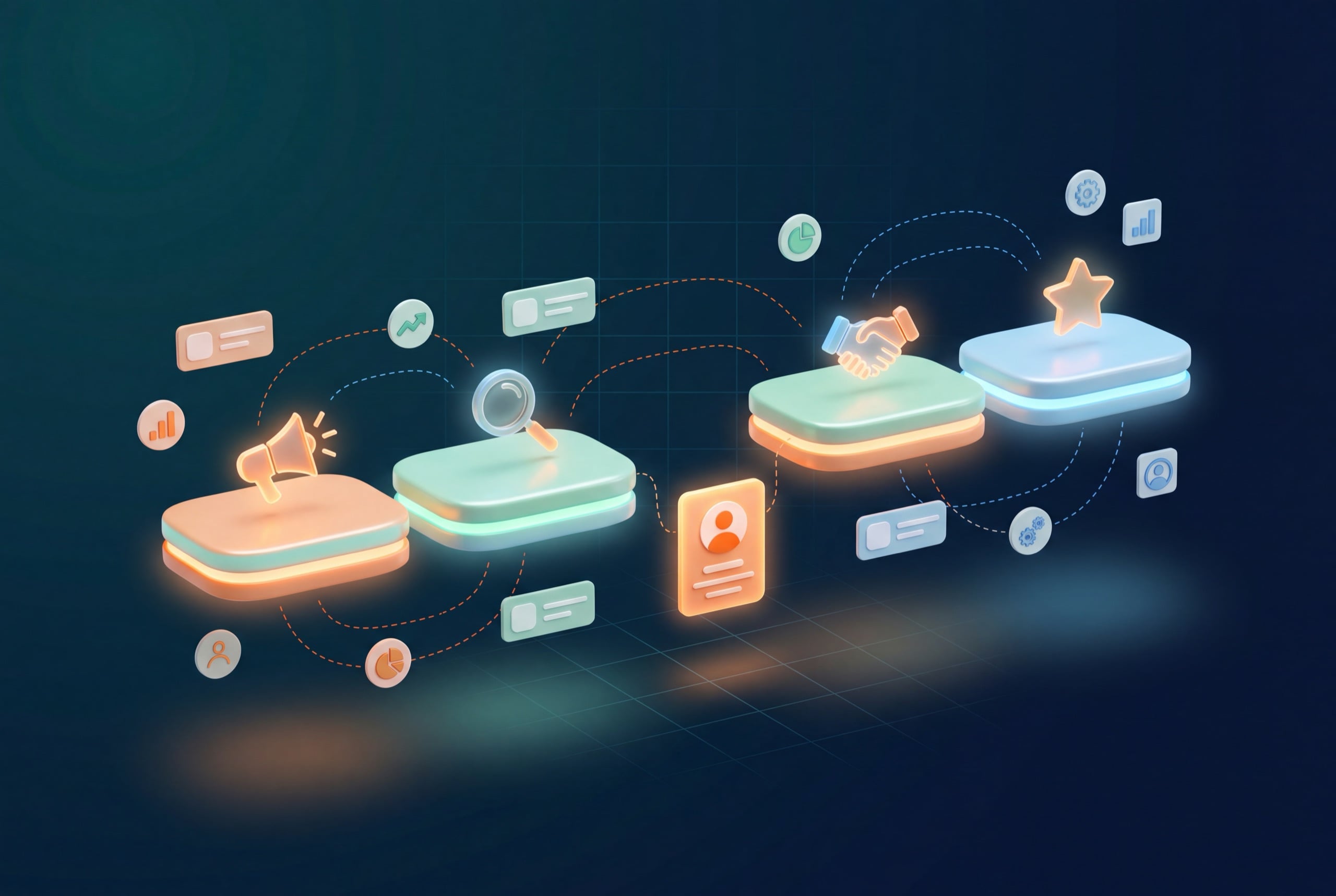
There is no universal number of stages. Common models use anywhere from three to eight. A set of five you will often see is awareness, consideration, decision, purchase and loyalty. The exact count matters less than two other things: whether your stages cover the time after the contract is signed, and whether each stage has an owner on your side.
Many models stop at the purchase. Yet McKinsey described the decision journey in 2009 as a cycle: the post-purchase experience shapes every later decision in the category, so the journey keeps going. Six years later, in 2015, McKinsey recalled that its model included a feedback loop in which customers keep evaluating products and services after the purchase.
Generic models describe the journey from the customer's point of view: what they think and what they do. In B2B, the five stages look roughly like this. The last column shows how you recognise each stage in your CRM. As an example we use the lifecycle stages in HubSpot, which by default are Subscriber, Lead, Marketing Qualified Lead, Sales Qualified Lead, Opportunity, Customer, Evangelist and Other.
| Stage from the customer's view | What the customer does | Lifecycle stage in the CRM |
|---|---|---|
| Awareness | Runs into a problem or an opportunity, for example an outdated system holding back growth. Reads articles, listens to peers in the industry and notices who talks about the topic. Is not talking to any vendor yet. | Subscriber |
| Consideration | Looks for possible solutions and compares vendors. Downloads content, reads case studies and asks around. When they want to know more, they fill in a form or sign up for a webinar. | Lead, Marketing Qualified Lead |
| Decision | Other people in the company join in, such as finance, IT or management. Talks to salespeople, compares offers, checks the risks and collects arguments to defend the decision internally. | Sales Qualified Lead, Opportunity |
| Purchase | Signs the contract and starts using the product or service. Expects to get exactly what the salesperson promised and to see a first result soon. | Customer |
| Loyalty | Uses the product, solves problems with support and keeps judging whether the investment pays off. Decides whether to order again, expand the relationship or go elsewhere. A satisfied customer recommends you. | Customer, Evangelist |
Treat this mapping of lifecycle stages as one option, not as dogma. The default stages in HubSpot can be edited, and you can add your own. If you use a different CRM, map the stages to its own statuses. Above all, make sure your data shows when a customer entered each stage.
At Buldok, we also look at the same journey from the other side, from the company's point of view. That is why we work with our own model, the Buldok Revenue Engine. It describes what a company should do at each stage to meet its business goals and, at the same time, give the customer as much value as possible. The company's stages do not match the customer's one to one. The Revenue Engine has six stages, and three of them start only after the contract is signed.
| Revenue Engine stage | What the company should do |
|---|---|
| Build awareness | Anchor the positioning and set up a content strategy that builds trust in the market before the customer ever talks to sales. |
| Uncover demand | Capture buying-intent signals in the market and turn them into qualified pipeline through a clearly defined lifecycle process and lead scoring. |
| Land deals | Install a sales process with clear rules that salespeople actually adopt and that revenue can be forecast against with confidence. |
| Deliver value | Set up onboarding and time-to-first-value so that in the first 90 days the customer gets exactly the product and service sales promised. |
| Optimize adoption | Track product and behavioural data, prevent churn proactively and systematically uncover upsell and cross-sell opportunities. |
| Keep growing | Turn contract renewals into an automatic process and build expansion on repeatable processes and systems, not on luck and the personal charm of one account manager. |
Each company stage needs an owner who is responsible for it and a metric that shows whether it works.
Customer journey touchpoints: where customers meet your company
A touchpoint is any place where a customer meets your company. An ad, a blog article, a form on your website, a call with a salesperson, but also an invoice or an email from support. Each one tells the customer something about how you will treat them from then on.
In B2B, touchpoints by stage usually look like this:
- Awareness: an ad, a LinkedIn post, an article, a conference talk, a recommendation from a colleague.
- Consideration: your website, case studies, comparisons, a webinar, a form, the first email.
- Decision: a meeting with a salesperson, a product demo, a proposal, references, the contract.
- Purchase: a welcome email, onboarding, the first invoice, access to the system.
- Loyalty: support, regular check-ins, a customer newsletter, the next order.
When teams map the journey, they often forget the touchpoints after the contract is signed. Yet an invoice with a mistake or three days without a reply from support say more about a company than the best campaign. And if customers dislike these moments, you usually find out only when you lose them.
The B2B customer journey: more people, a longer path, more handoffs
In B2B, one person doesn't decide, and nobody decides straight away. On the customer's side there are several people with different questions. On your side, the customer meets marketing, sales, onboarding and support one after another. Every handoff between them is a place where the journey can break.
According to a 2025 Gartner survey, B2B buying groups range from five to 16 people across as many as four functions. The finance director wants to know when the investment pays back. IT cares about security and how the solution fits existing systems. The future user wants to know whether it will make their work easier. A map that assumes a single "customer" misses all of this.
Buyers also go through a large part of the journey on their own. In 2025 Gartner published another result from a survey of 632 B2B buyers: 61 % of them prefer an overall rep-free buying experience. That is a clear majority.
That doesn't mean they never want a salesperson. They are more likely to want one at the moment a salesperson can offer something they cannot find on their own. Until then they read your website, compare options and ask their peers. And when they finally get in touch, they reach the most sensitive point of the whole journey: the handoff from marketing to sales.
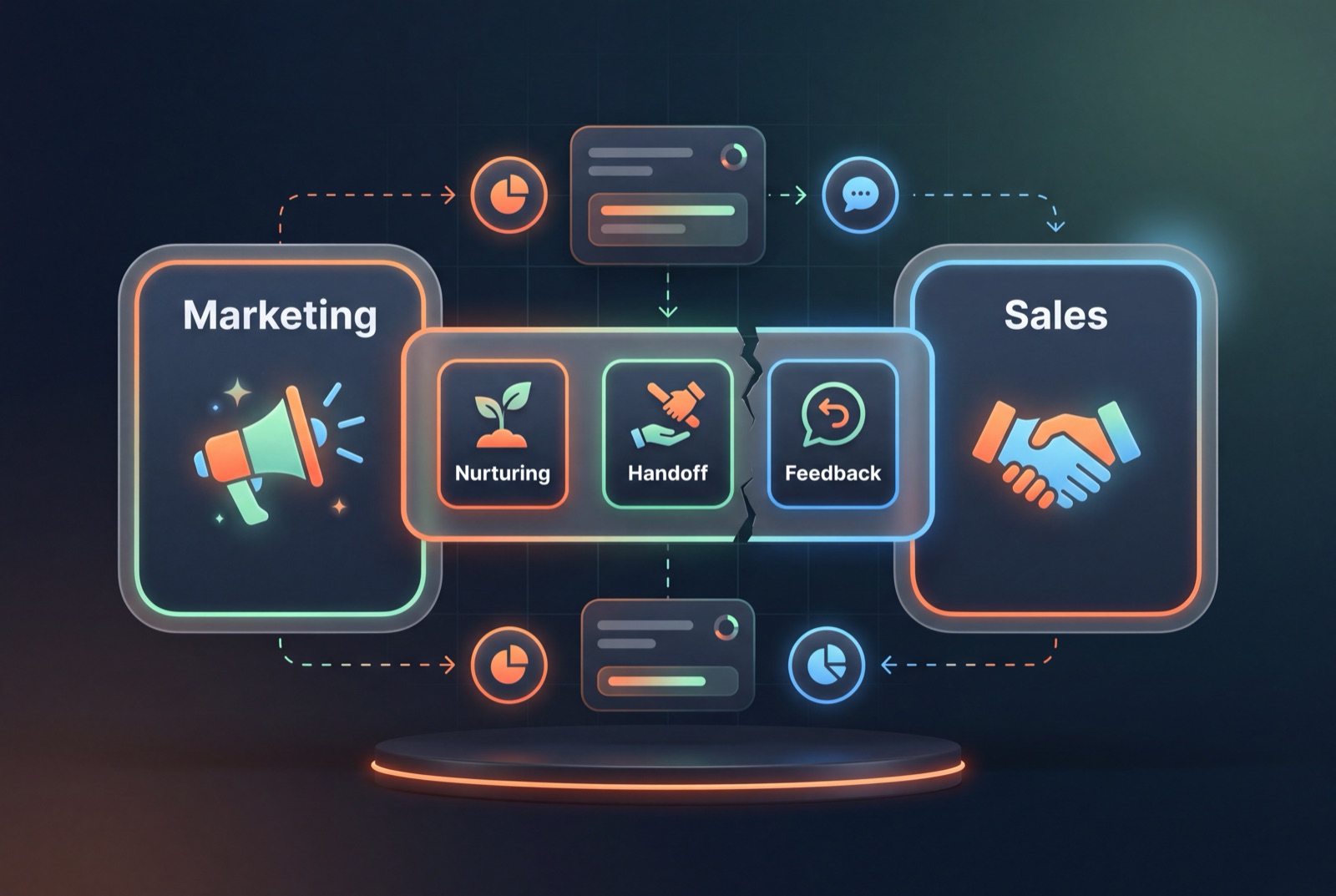
Where leads get lost: between marketing and sales
Most often at the handoff between marketing and sales. This is not true of every company, but at Buldok we deal with it every day. In our experience, only a minority of companies share one CRM across teams, and marketing often does not go much further than building awareness.
It usually looks like this. The company runs ads and leads come in. But nothing is ready for the moment after someone fills in the form. There is no nurturing, meaning gradual follow-up with leads who are not yet ready for sales. There are no handoff rules and no feedback from sales back to marketing. When a lead finally reaches sales, whether anyone works on it depends entirely on how proactive the particular salesperson is.
Speed matters here. An HBR study from 2011 looked at 1.25 million leads in 42 US companies, most of them consumer-facing. In the 2011 study, firms that tried to reach a lead within an hour were nearly seven times as likely to qualify it as firms that tried an hour later. In a 2011 audit of 2,241 US companies, 37 % responded to a test web lead within an hour. In the same 2011 audit, 23 % never responded at all.
A more recent test by RevenueHero from 2024 sent demo requests to 1,000 B2B SaaS websites and received only 365 responses. RevenueHero sells lead routing software itself, and the test used a different sample and method, so it cannot be compared directly with the 2011 figures. Even so, it shows that plenty of web enquiries go unanswered.
When is a lead ready for sales? When it matches your ideal customer profile (ICP), is qualified and has a sufficient score. Sales should then get in touch as soon as possible.
The way back matters just as much. Sales should tell marketing whether the lead was any good. An automated email with a short survey that the salesperson answers with one click works well. A simple internal process in the CRM does the job too.
This is where it becomes clear why marketing, sales and support should work in one shared CRM. Marketing sees what happened to its leads. The salesperson sees what the customer read and asked about. Support knows what sales promised. Without shared data, each team keeps its own piece of the journey and nobody sees the whole. We describe how to set up the handoff between marketing and sales on our Uncover demand page.
How to create a customer journey map in six steps
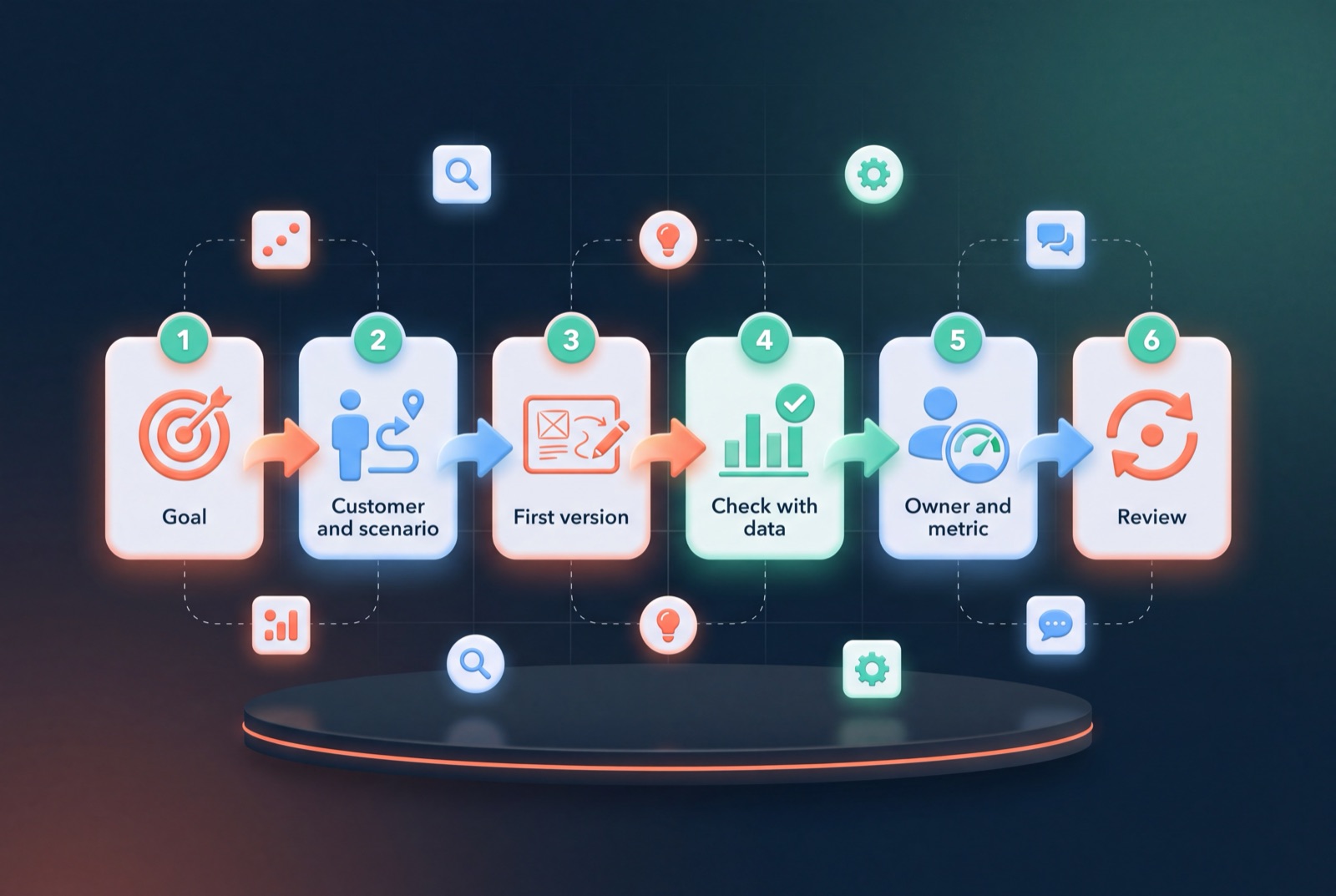
You build a customer journey map in six steps. They run from a single question the map should answer, through a first version drawn from your team's knowledge, to an owner and a metric for each stage. Below is the process you can follow to build it.
1. Set the goal and the scope
The map should answer one specific question, for example: where do we lose leads between the form fill and the first meeting? Or: why don't new customers order again after their first purchase? Without a question like this, you end up with a map of everything, which means a map of nothing.
2. Choose one type of customer and one scenario
According to Nielsen Norman Group in 2018, journey maps share five key elements: an actor, a scenario with expectations, journey phases, actions with mindsets and emotions, and opportunities. The actor is one type of customer, ideally described as a persona. The scenario is a specific situation, such as a new customer's first enquiry.
3. Build a first version from what your teams know
Before you draw the map, walk the journey yourself as a customer. Then meet every team that deals with customers: marketing, sales, onboarding and support. One workshop with each team is enough. Each team knows its own part of the journey, and only together do you see the whole, including the points where teams hand the customer over.
A rough map from memory is better than none, so don't wait until you have perfect data.
4. Check the map against CRM data and customers
Compare what your teams believe with what the CRM shows. Where do leads stall? How long does the handoff from marketing to sales take? How many leads have no further activity after the handoff? A few conversations with customers will then show you things the data cannot.
Here is a simple example of what this step can reveal. A company selling industrial equipment walks its own journey and finds that demo requests sit in a shared inbox for days before anyone picks them up. In the CRM, those leads have no owner and no activity. The map now has its first concrete gap with a name on it.
Allow one to two weeks to work through the outputs of the workshops and the data.
5. Give each stage an owner and a metric
The owner is a specific person, not a department, and the metric is a single number that shows whether their stage works. For example, the share of leads sales contacts on the same working day, or the time it takes a new customer to see a first result.
6. Review the map regularly
A map ages with every change to your offer, your team or your market, so go through it with the stage owners once a quarter. Look at what has changed, which metrics are moving and where the journey is getting stuck again.
Common journey mapping mistakes
The most common mistake is having no map at all. The others appear when a map does get made, but nobody works with it.
- No map. In 10 years of practice, we have come across only one or two companies that had a formal customer journey map. Yet the journey exists either way. Without a map, nobody can see it, so nobody manages it.
- The journey ends at the first sale. Without a written map, many companies treat the signed contract as the final stop and have no plan for what happens next. Yet the first purchase is exactly where automated upsell and cross-sell steps based on what the customer bought come in, along with expansion into new product and service categories. We describe how to approach this on our Keep growing page.
- No owner. The workshop ends, the map is saved to a shared folder and nobody is responsible for it, so a few months later nobody opens it.
- Stages that don't match the data. If the map describes stages you can't recognise in the CRM, you can't measure where customers get stuck. The map then stays an opinion.
- A one-off project. Your offer, team and market change, so a map nobody has opened for a year describes a company that no longer exists.
- One map for everyone. A new customer and a customer placing their tenth order go through different journeys. Merge them into one map and you won't see either of them clearly.
Tools for customer journey mapping: what to use for what
You don't need any special tool for your first map. A whiteboard, sticky notes and people from every team in one room will do. A tool starts to matter once you share the map, maintain it and check it against data.
Isn't a spreadsheet enough? For the first version, yes. But once you want to check the map against data and keep it up to date across several teams, a spreadsheet on its own stops being enough.
| Category | What it is good for | Examples |
|---|---|---|
| Paper, whiteboard, spreadsheet | A rough first version and quick changes without learning a new tool | Sticky notes, Excel, Google Sheets |
| Online whiteboard | Working on the map together when the team is not in one room | Miro, FigJam, Mural |
| Journey mapping software | Managing several maps and personas once you map regularly and at scale | Smaply, UXPressia |
| CRM and analytics | The data that checks the map: where leads stall, how long the handoff takes, who owns the customer | HubSpot, Salesforce, Pipedrive, Google Analytics |
The last row of the table matters most. A whiteboard shows how you imagine the journey, while the CRM shows how it really runs. If the map doesn't match the data in the CRM, trust the data and change the map.
So when you choose a tool, don't ask which one draws the nicest diagram. Ask where the stages, owners and metrics will live day to day. It's fine if the team opens the map itself only for the quarterly review. Stages and metrics that nobody sees in their daily work, however, don't work.
Frequently asked questions about customer journey mapping
What is the difference between a customer journey and a funnel?
A funnel measures how many people move from one stage to the next and usually ends at the purchase. A customer journey describes what the customer does and experiences at each stage. It also continues after the contract is signed. The two views complement each other.
How many stages does a customer journey have?
There is no fixed number, and common models use three to eight. What matters more than the number is that the stages cover the time after the purchase and that each stage has an owner.
Who should own a customer journey map?
Each map should be owned by one specific person, and a company usually has several maps, by customer type, scenario or product line. According to Nielsen Norman Group in 2021, each journey needs its own owner, because one person cannot manage several journeys well, and that owner should report to someone in leadership. In a smaller company with one main journey, one person can be enough.
How often should you update a customer journey map?
Once a quarter with the stage owners, and whenever your offer, team or market changes significantly. After a year without a review, the map describes a different company.
What is the difference between a user journey map and a customer journey map?
A user journey map usually follows one task in a product or on a website, such as signing up. A customer journey map covers the whole relationship with the company, from first awareness to repeat orders.
Do you need special software for customer journey mapping?
No. A whiteboard and sticky notes are enough for the first version. What matters most is that the stages and metrics live in the CRM, where teams work with them every day.
Where to start
Start by writing down your current journey, even if it is rough. For the first rough version, one shared afternoon with people from marketing, sales and support is enough. The detailed workshops with each team come later, when you build the map properly.
- Put yourself in your customer persona's shoes and walk the journey through their eyes, step by step and touchpoint by touchpoint. Fill in the form on your own website, wait for the reply and go through the proposal, the contract and the first invoice. Only this shows you what the journey really looks like, not what you imagine it looks like.
- Write each step down against the customer's stages in the first table above, and note who looks after the customer on your side at each one.
- Mark the places where nobody owns the customer. Typically these are the moment after the form fill, the handoff to sales and the first weeks after the contract is signed.
- For each of these places, choose an owner and one metric.
The resulting map won't be perfect. It will show you where customers get lost, though, and that is more than many companies know about their own journey.
If you want to be sure you haven't missed an important weak spot, get in touch. In a free 30-minute consultation, we'll go through your customer journey together and show you where leads get lost and where nobody owns the customer.