
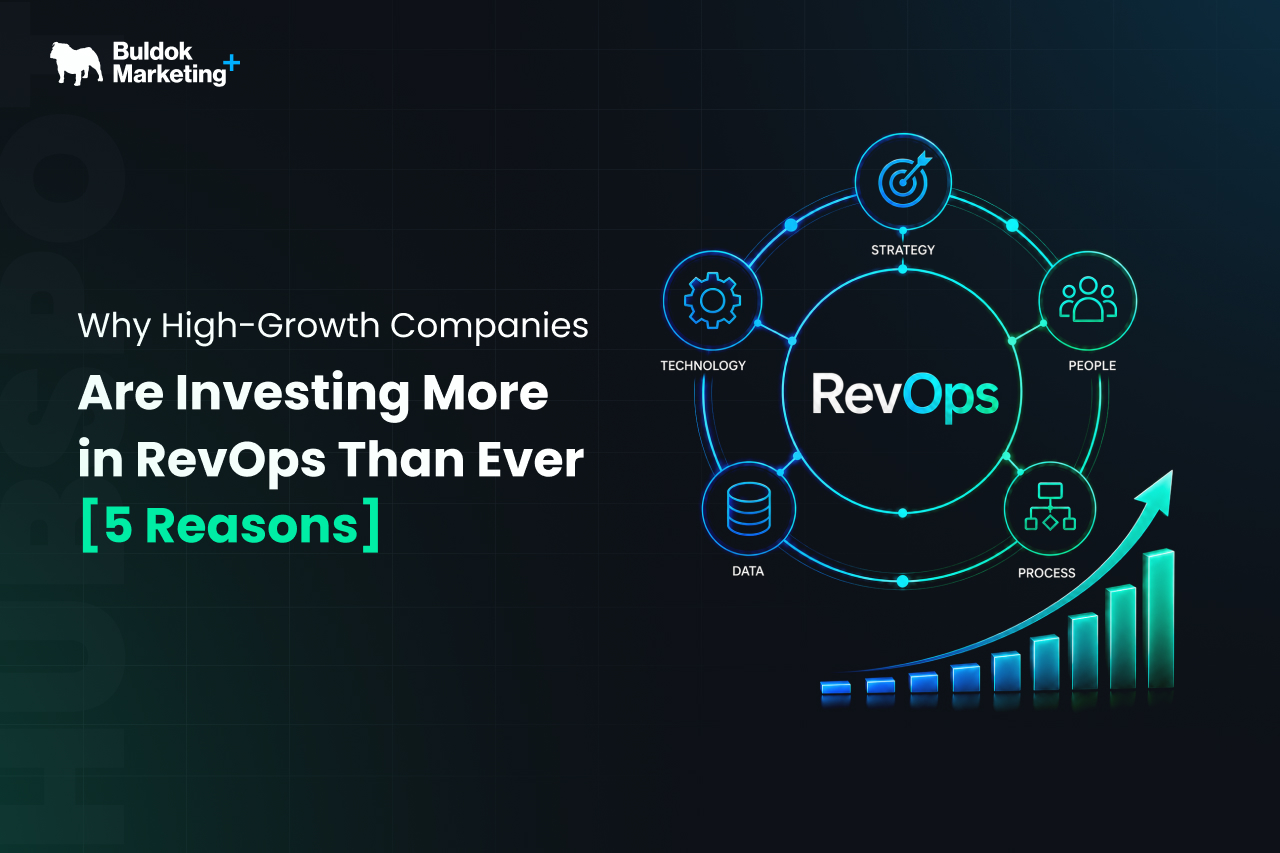
Growth creates opportunity, but it also creates operational pressure. As a company adds marketers, products, salespeople, channels, and customer segments, its revenue process becomes harder to manage. This is why high-growth companies are putting more money and technology behind Revenue Operations (RevOps).
RevOps is no longer treated as a reporting function that maintains dashboards after decisions have been made. It is becoming the operating system that connects strategy, execution, data, technology, and accountability across the revenue engine.
According to SyncGTM, 78% of B2B companies now have a dedicated RevOps function running, up from 48% in 2023. This rise shows that businesses are realising the hardships of managing operations in silos and adopting RevOps as a solution to align everything under one structured process.
Companies Are Investing in RevOps Because Growth Is Becoming Harder to Coordinate
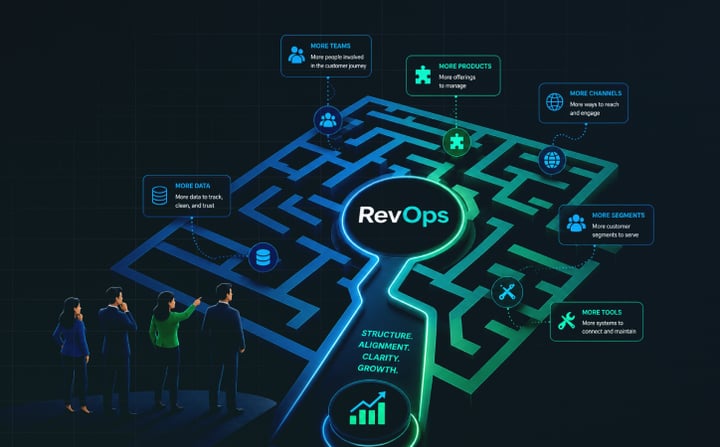
In an early-stage company, revenue operations can appear simple. A small group shares information directly, leaders remain close to important deals, and one spreadsheet can hold the forecast.
That model weakens as the company grows. More people participate in the customer journey, more software enters the stack, and more decisions depend on reliable data. Every buyer interaction creates data, ownership questions, and handoffs.
RevOps creates the structure required to manage this complexity. It defines how demand becomes pipeline, how pipeline becomes revenue, and how customer outcomes create retention and expansion. Without that structure, growth adds volume and friction at the same time.
5 Reasons Why Having RevOps Is Becoming Essential for Companies
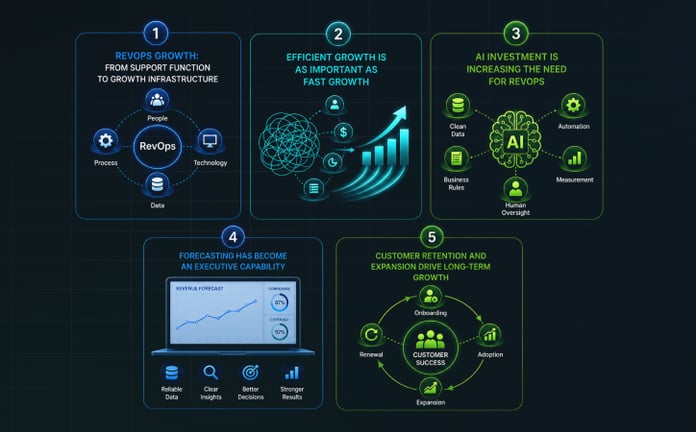
1. RevOps Growth: From Support Function to Growth Infrastructure
Traditionally, marketing operations managed campaign platforms and lead data. Sales operations maintained territories, pipelines, and forecasts. Customer success operations handled onboarding, usage, and renewals.
RevOps changes this. Instead of improving one department at a time, it improves the system through which revenue is created and retained. It strategically aligns resources across marketing, sales, partner ecosystems, and customer success. Ultimately, it integrates people, processes, and technology around trusted revenue data.
This explains why companies are investing beyond a single RevOps hire and are funding data architecture, automation, integrations, forecasting, attribution, enablement, and governance.
2. Efficient Growth Is As Important As Fast Growth
High-growth companies once responded to rising workloads by adding more tools, hiring more people, or creating temporary workarounds. While these solutions may help in the short term, they can also increase costs and make the revenue process harder to manage.
RevOps helps companies understand where time, budget, and team effort are being wasted. Once these inefficiencies are identified, teams can determine whether they need new technology or simply need to improve the systems and processes they already have.
A strong RevOps function examines whether the process is clear, existing tools are being used correctly, and information can move between teams without manual updates. In many cases, simplifying the technology stack and improving existing systems can deliver more value than purchasing new software.
For instance, if you use HubSpot regularly, timely HubSpot optimization is necessary. As the company changes, its pipeline stages, scoring models, integrations, dashboards, and workflows must change as well. Without regular improvement, HubSpot may continue supporting outdated processes instead of helping the business reach its next stage of growth. Through proper optimization, this challenge is easy to overcome.
3. AI Investment Is Increasing the Need for RevOps
Artificial intelligence has added another reason to strengthen revenue operations. Teams are adopting AI for research, content, prospecting, summaries, forecasting, personalisation, and customer support. Yet AI-generated results become reliable only when it has access to clean data, clear business rules, and connected customer context. RevOps helps here.
It defines which data AI can use, which tasks can be automated, when human approval is required, and how impact should be measured. It also prevents departments from building separate AI workflows that duplicate effort or create conflicting customer experiences.
4. Forecasting Has Become an Executive Capability
Forecasting is one of the clearest areas where RevOps produces strategic value. In a fragmented organisation, the forecast is assembled from subjective deal updates, incomplete CRM records, and late-stage judgement. Leadership receives a number, but not always a reliable explanation of what is driving it.
RevOps improves the system behind the forecast. It creates consistent opportunity stages, exit criteria, pipeline definitions, required fields, deal inspection routines, and reporting standards. It can connect marketing demand, sales activity, conversion history, deal velocity, and customer expansion signals.
As a result, forecast leaders can easily trace and act on weak demand, poor qualification, slower progression, lower win rates, or insufficient coverage.
5. Retention and Expansion Are Now Part of the Revenue Engine
Many companies originally built their operations around customer acquisition. Marketing created leads, sales closed deals, and the operational model largely ended at the contract. That is no longer sufficient for recurring-revenue and long-term B2B models.
Customer onboarding, adoption, service quality, renewal risk, expansion readiness, and advocacy all affect future revenue. If this information remains scattered, the company cannot manage it consistently.
RevOps connects the post-sale journey to the same operating model used for acquisition. Health scores can combine usage, support activity, engagement, commercial history, and feedback. Renewal and expansion workflows can then respond to real signals. The result: customer focus turns from an aspiration into a measurable process.
What High-Growth Companies Are Actually Funding
More RevOps investment does not always mean building a large central department. The right model depends on company size, complexity, maturity, and internal capability. What matters is that the essential work has clear ownership.
In practice, investment usually covers several connected areas:
- Revenue process design, including lifecycle stages, qualification, handoffs, pipeline rules, onboarding, renewals, and expansion
- Data governance, including definitions, required fields, deduplication, enrichment, ownership, and quality controls
- Technology architecture, including CRM configuration, integrations, automation, permissions, and stack rationalisation
- Measurement and planning, including attribution, forecasting, conversion, velocity, customer health, and unit economics
- Enablement and adoption, including documentation, training, playbooks, change management, and accountability
HubSpot Can Become the Foundation For RevOps Implementation, but Configuration Matters
For companies using HubSpot, RevOps is the discipline that turns the platform from a collection of tools into a connected revenue system. HubSpot Smart CRM can bring marketing, sales, service, and customer data into a shared foundation. HubSpot itself positions Smart CRM as a single source of truth across the customer platform.
The platform alone does not create alignment. Teams still need agreed definitions, reliable integrations, useful dashboards, clean data, and ongoing ownership as the business changes.
A well-designed HubSpot environment can reduce manual handoffs, automate follow-up, standardise qualification, improve forecast visibility, and connect acquisition with retention. A poorly governed environment can become another source of duplicate records, unused features, conflicting reports, and hidden work.
The difference is RevOps. It ensures the system follows the revenue strategy and that teams use it consistently. Technology provides the capability, while RevOps turns that capability into business performance.
What’s The Result of Underinvesting in RevOps Today?
Companies rarely experience one dramatic moment that proves they need RevOps. The warning signs accumulate. Some of them include:
- Forecast meetings become debates about data.
- Sales builds private spreadsheets.
- Marketing cannot explain pipeline contribution.
- Lead routing slows as territories change.
- Customer success learns about risk too late.
- AI pilots produce promising demos but struggle to reach daily workflows.
Together, these issues create a revenue engine that becomes less predictable as the company grows. The organisation spends more time reconciling information and fixing exceptions.
Investing earlier gives companies more control, such as designing processes before workarounds become harder, establishing data standards before the database becomes difficult to repair, building automation around agreed rules, and measuring growth using shared definitions.
RevOps is not an expense created by complexity. It is an investment that prevents complexity from becoming a permanent drag on growth.
Final Verdict
High-growth companies are investing more in RevOps because revenue has become a cross-functional system. Marketing cannot create efficient growth without sales feedback. Sales cannot forecast accurately without clean data and consistent processes. Customer success cannot protect revenue without visibility into the full relationship. AI cannot perform reliably without connected context and governance.
RevOps brings these dependencies together. It helps companies replace isolated activity with coordinated execution, reduce operational waste, improve decision quality, and build a revenue engine that can adapt as the business changes.
The companies gaining the most value are not treating RevOps as a new name for sales operations. They are treating it as essential infrastructure for efficient growth, stronger customer relationships, and greater confidence in revenue decisions.
If your existing processes, data, or HubSpot setup are making growth harder to manage, contact Buldok Marketing to discuss how a more connected RevOps approach can support your next stage of growth.