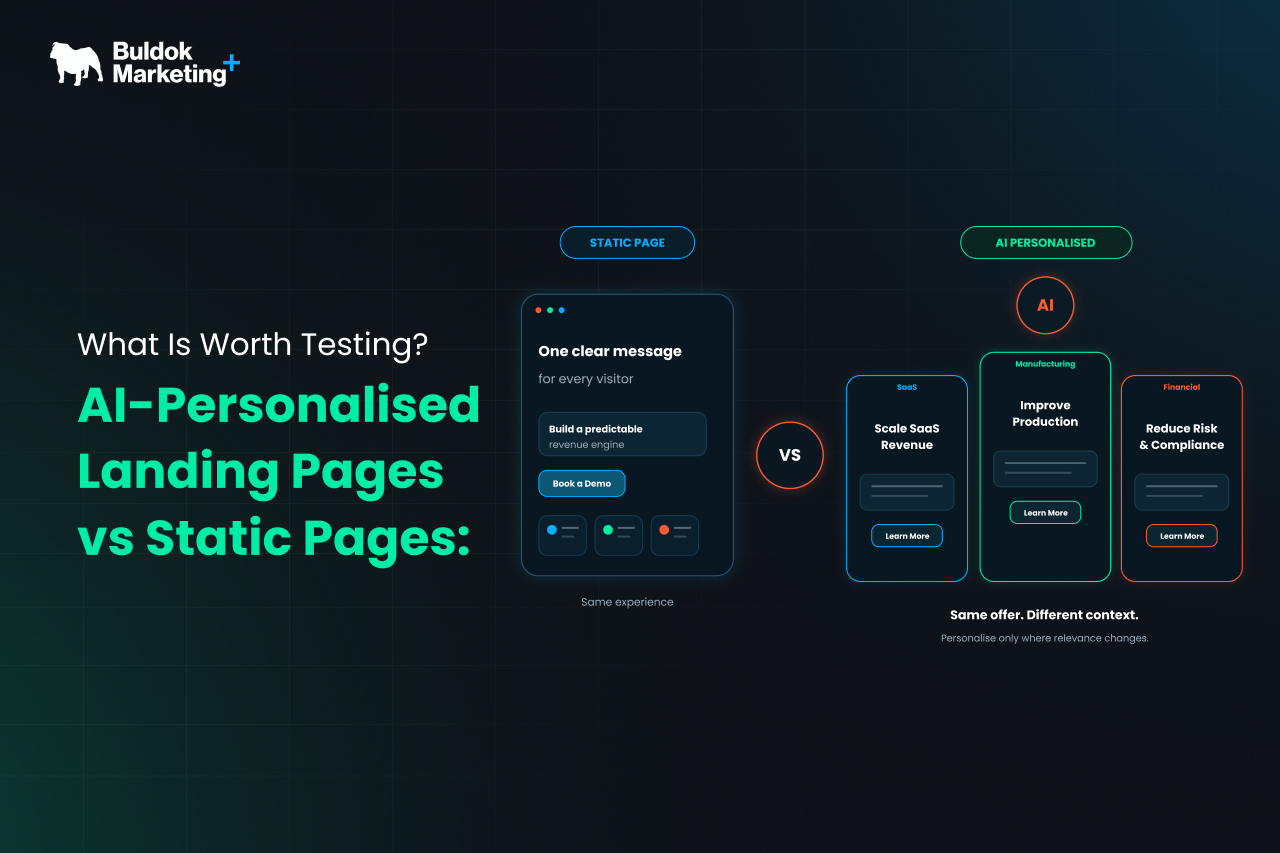
Landing page personalisation sounds like an obvious improvement. If two visitors have different needs, industries, buying stages or relationships with your company, why should they see exactly the same page?
AI makes the idea even more attractive. Marketing teams can create landing page variations faster and use CRM data to personalise them. They can also adapt the page to each visitor's context without building dozens of separate pages by hand.
But personalisation alone does not improve conversion rates. A well-designed static page with clear messaging can outperform a personalised page built on weak data. The same goes for a page with irrelevant variations, or one where you can no longer tell what actually caused a change in performance.
So which should you use?
For most B2B teams, the answer is a sequence rather than a choice. Start with a strong static control, identify meaningful differences in your audience, and test personalisation only where those differences should reasonably affect the buying decision.
That gives you personalisation without turning your landing page strategy into uncontrolled experimentation.
What Is an AI-Personalised Landing Page?
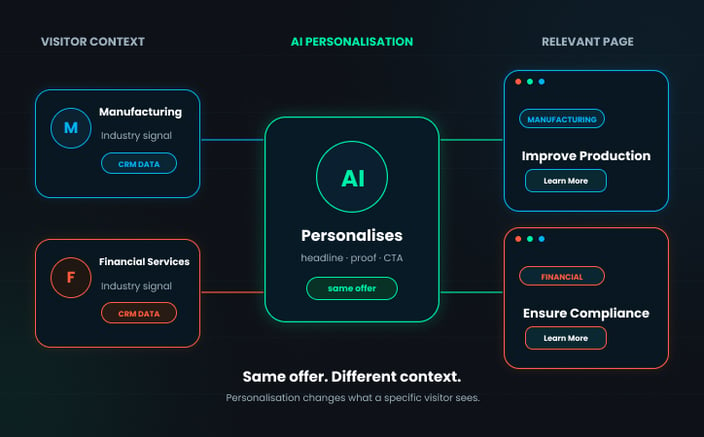
An AI-personalised landing page adapts part of the visitor experience to the information you have: behavioural signals, CRM data or audience context. AI plays two roles here. It helps you create variations faster, and in some tests it sends more visitors to the variation that performs better on its own. Who sees which version, though, is decided by rules you set.
The personalised elements can be the headline, supporting copy, use cases, industry examples, customer proof, images, CTAs, forms or recommendations.
For example, an enterprise software company might show a manufacturing visitor a headline about production efficiency, while a financial services prospect sees a message about compliance and data visibility. The underlying offer stays the same. What changes is the context used to explain its relevance.
Before you test anything, keep two things apart. AI-generated content helps marketers produce the page. Personalisation changes what a specific visitor sees.
HubSpot shows the difference well. With Content Remix, its AI can generate new landing and website pages from your existing page templates. Smart content is a separate feature. It changes what a visitor sees by country, device type, referral source, ad source, preferred language, list membership, lifecycle stage or query parameters (HubSpot knowledge base). On landing pages, both need Content Hub Professional or Enterprise.
What Is a Static Landing Page?
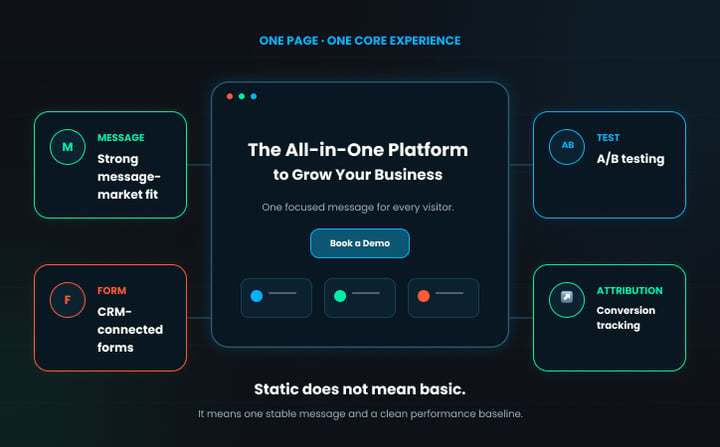
A static landing page shows the same core experience to every visitor. That does not make it unsophisticated. A static page can still have:
- Strong message-market fit
- Excellent UX
- CRM-connected forms
- Progressive profiling
- Conversion tracking
- A/B testing
- Dynamic form behaviour
- Campaign attribution
- Automated follow-up
"Static" simply means you are not significantly changing the page's message for an individual visitor or segment.
For many campaigns, that simplicity is valuable. If everyone clicking an ad already belongs to a tightly defined audience with the same problem and offer, extra personalisation may solve a problem that does not exist.
AI-Personalised Landing Pages vs Static Pages: Which Is Better?
Neither approach is universally better. The right choice depends on how different your visitors actually are.
| Static Landing Page | AI-Personalised Landing Page |
| Best for one focused audience and lower traffic | Makes sense for several distinct segments with enough traffic |
| Easier to build and maintain | Requires more data and governance |
| Easier to test and troubleshoot | More variables affect results, and it needs ongoing QA |
| Provides a clean performance baseline | Can improve message relevance |
| Lower risk of incorrect personalisation | More dependent on accurate CRM data |
When Is a Static Landing Page Worth Keeping?
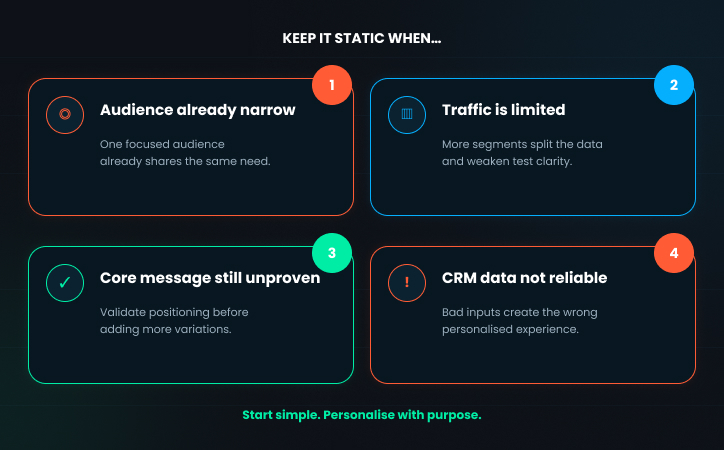
AI personalisation gets attention because it feels more advanced. Yet in several situations a static page remains the better starting point.
1. Your Audience Is Already Narrow
Suppose you run a LinkedIn campaign aimed exclusively at RevOps leaders in mid-market B2B SaaS companies.
The ad, audience, landing page and offer are already highly specific.
Personalising that page further may add very little relevance.
Improving the core proposition, social proof, CTA or form is likely to have a greater impact.
2. Your Traffic Is Limited
Every additional personalisation segment divides your data.
A landing page receiving 500 visits does not become more useful because those visitors are split into five personalised experiences of 100 visits each.
The more variations you create, the harder it is to tell whether differences in performance are meaningful or simply noise.
With limited traffic, test bigger hypotheses on a shared page first.
3. You Are Still Validating Your Core Message
Personalisation cannot rescue weak positioning.
If you do not yet know which problem, value proposition, offer or proof point resonates with your market, multiple personalised versions only add complexity.
First establish a message that works.
Then identify whether particular segments need a different version of it.
4. Your CRM Data Is Not Reliable Enough
This matters most where the personalisation runs on CRM data, for example HubSpot's lifecycle stage or list membership rules.
Imagine personalising a page by lifecycle stage when lifecycle stages are inconsistently maintained.
A current opportunity might see top-of-funnel messaging. An existing customer could receive a "book your first demo" CTA. A known enterprise buyer might get generic content because an important CRM property is empty.
Personalisation magnifies the value of good data, and it magnifies the consequences of bad data just as much.
When Is AI Personalisation Worth Testing?
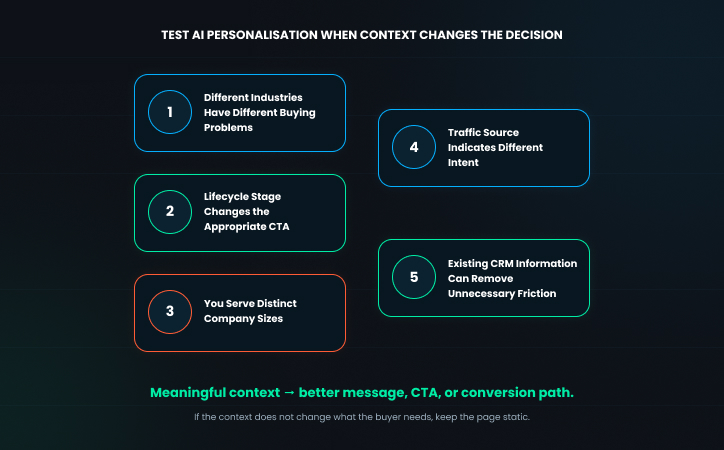
Personalisation becomes interesting when audience context should genuinely change what someone needs from the page.
1. Different Industries Have Different Buying Problems
A single platform might serve manufacturers, financial companies, professional services firms and technology businesses.
The product may be identical, but the buying logic is not.
An industry-specific variation could change:
- The headline
- Operational challenges
- Product use cases
- Relevant integrations
- Customer examples
- Terminology
That is a stronger personalisation hypothesis than adding the visitor's company name to the page.
2. Lifecycle Stage Changes the Appropriate CTA
A first-time visitor and an active opportunity should not necessarily receive the same next step.
An early-stage visitor might see:
Download the guide
A marketing-qualified lead could see:
See how the platform works
A sales-qualified prospect might see:
Book your consultation
An existing customer could see:
Talk to your account team
HubSpot is useful here because its smart content rules include lifecycle stage and contact list membership, which work only for tracked, known contacts. In the current CTA editor, smart rules can also show different versions of a CTA to different viewer categories (HubSpot knowledge base).
3. You Serve Distinct Company Sizes
Larger companies tend to buy with more people and more process around the decision. Check whether your enterprise prospects need different arguments from smaller ones.
They may care more about:
- Governance
- Security
- Implementation
- Integrations
- Permissions
- Scalability
- Reporting
- Cross-team processes
A smaller business might put speed, simplicity and implementation effort first.
If your CRM or campaign data gives you a reliable company-size signal, this can become a useful personalisation test.
4. Traffic Source Indicates Different Intent
Someone arriving from a product-specific Google Ads campaign has told you something different from someone clicking a broad LinkedIn awareness ad.
Personalising by campaign or referral context helps keep the message continuous.
The visitor should feel that the landing page continues the conversation the ad started.
HubSpot smart content can use ad source, referral source and query parameters as rule criteria, so this type of experiment is possible inside the platform.
5. Existing CRM Information Can Remove Unnecessary Friction
Personalisation does not always need to change the copy.
Sometimes the more valuable experiment is changing the conversion experience.
Returning visitors may not need to type the same information again. Returning contacts might receive a different CTA. Existing customers may need a completely different route.
That is where personalisation becomes part of revenue operations, beyond a website optimisation tactic.
What Should You Actually Test?
Do not begin by personalising everything. Start with variables that could realistically influence the visitor's decision.
Test 1: Personalised Headline vs Universal Headline
Control:
"Build a More Predictable Revenue Engine"
Personalised version for SaaS:
"Build a More Predictable SaaS Revenue Engine"
Do not stop at inserting an industry name, though. A stronger test changes the value proposition itself:
SaaS variation:
"Connect Acquisition, Pipeline and Renewals in One Revenue System"
The value-proposition version tests whether industry context improves the message. Inserting a label alone only creates the illusion of personalisation. If that version wins, you still do not know whether the industry angle worked or simply the better-written message. So compare it with a universal version of the same message as well.
What does such a test look like end to end? The signal can be the traffic source: visitors from a campaign aimed at SaaS companies arrive with a URL parameter. On the landing page you set a smart content rule on that parameter, so campaign visitors see the value-proposition headline. Everyone else sees the default version. The Smart Content tab then shows how the smart content performed compared to the default content. The two groups came from different sources, though, so this is a comparison rather than a clean test. A clean result comes from an A/B test of both headlines on the same audience. In both cases, set the metric, the number of conversions you need and the end date before you start.
Test 2: Segment-Specific Social Proof
Personalised proof may be more powerful than personalised headlines.
A manufacturing visitor may find a manufacturing case study more persuasive than a generic testimonial.
You could test:
- Industry-specific logos
- Relevant case studies
- Similar company sizes
- Role-specific testimonials
- Use-case-specific results
The underlying page stays stable while the credibility layer becomes more relevant. The signal can be a list of contacts from that industry, which works only for known contacts. Anonymous visitors are reachable through a campaign aimed at one industry and a rule on ad source or a URL parameter.
Test 3: Personalised Use Cases
Different roles may buy the same platform for different reasons.
A marketing leader might care about:
- Attribution
- Lead generation
- Campaign performance
A sales leader might care about:
- Pipeline management
- Forecasting
- Lead follow-up
A RevOps leader might care about:
- Data consistency
- Lifecycle management
- Automation
- Cross-functional reporting
Testing role-based use cases shows whether greater relevance moves more prospects towards conversion. The signal can be a list of known contacts by job title, or a campaign aimed at one role with a URL parameter.
Test 4: CTA by Buying Stage
Instead of showing everyone "Book a Demo", test whether the CTA should reflect how ready the visitor is.
This is especially useful in long B2B buying cycles, where not every qualified visitor is ready to speak to sales straight away.
Test 5: Form Experience
The form itself may offer a better testing opportunity than the hero copy. HubSpot forms pre-fill fields that a returning visitor has already submitted on the same device. In the updated form editor, form shortening asks for an email address first and hides fields that enrichment data can fill. Progressive fields, which swap an answered question for a new one, now exist only in the legacy form editor. For more ideas, see our guide to increasing conversions with HubSpot forms.
Consider testing whether known contacts should see fewer questions, while unidentified visitors provide the information you need for qualification.
The highest possible form conversion rate is not necessarily the goal.
What you want is enough information to move the right prospect forward without unnecessary friction.
Watch Out for Over-Personalisation
More personalisation is not automatically better personalisation. Customising every paragraph, visual, offer, CTA, testimonial and form for every audience creates several problems.
- You Lose Test Clarity: If ten things change between the control and the personalised version, you do not know why performance changed.
- Maintenance Expands Quickly: Five segments across four campaigns can quickly turn into dozens of experiences that need ongoing review.
- Incorrect Data Produces Awkward Experiences: CRM values change. Lists become outdated. Contact records have gaps. Every personalisation rule creates another dependency.
- Brand Consistency Can Drift: AI makes it faster to create content variations, and that speed also makes it easier to generate inconsistent claims, terminology, offers and positioning.
This is why AI-powered personalisation needs governance around data, messaging, testing and ownership.
How to Build a Practical Landing Page Testing Framework
Instead of asking "Should we personalise our landing pages?", use the following process.
Step 1: Define the Conversion Goal
Decide exactly what success means.
Is the page meant to generate leads, qualified demos, webinar registrations, opportunities or revenue?
Step 2: Build the Static Baseline
Create the strongest version you can for the primary audience.
Measure its current performance.
Step 3: Name the Segment Difference That Changes the Message or Next Step
Pick a group of visitors that might need its own version of the page: an industry, a lifecycle stage, a company size or a traffic source. Then answer: what do we know about this group, and why should it see a different message, different proof or a different CTA from the primary audience? Look in your CRM, for example at conversions or closed deals by industry and company size, form answers and sales notes from first meetings. If you have no concrete answer, the group does not need its own version, so park the personalisation for now.
Step 4: Choose One High-Impact Variable
Start with one meaningful area, such as:
- Value proposition
- Industry use case
- Proof
- Offer
- CTA
Avoid personalising the entire page at once.
Step 5: Validate the Data Source
Make sure the CRM property, list, URL parameter, campaign source or behavioural signal behind the personalisation is accurate.
Step 6: Run the Experiment
Compare the personalised experience with the control. Before you launch, write down how you will pick the winner, how many conversions per variation you need and when the test ends.
Avoid making unrelated changes while the test is running.
Step 7: Measure Down-Funnel Impact
Look beyond page conversion. A qualified lead tells you more than a form submission, and new pipeline tells you more than a qualified lead.
Connect the experiment to CRM outcomes and assess lead quality, pipeline and revenue where possible.
Step 8: Scale Only Proven Personalisation
Once a personalisation hypothesis has shown its value, extend it carefully to another segment or page.
Do not build 20 personalised pages because one experiment worked.
Where HubSpot Fits Into This Strategy
HubSpot gives marketing and RevOps teams a useful environment for this kind of experimentation, because content, CRM data, conversion activity and downstream customer records live in the same platform.
For landing pages, HubSpot offers smart content and A/B tests, both with Content Hub Professional or Enterprise. Every account also gets performance data per page, such as views, form submissions and new contacts.
AI is reducing the production work as well. Content Remix generates new website and landing pages from your existing templates, which helps teams create variations while keeping the site more consistent.
The second role of AI is in testing. A HubSpot adaptive test compares up to five page variations and gradually shows the best performer to visitors more often. It needs Content Hub Professional or Enterprise, and every variation must include a form. HubSpot introduced it in 2024 as A/B testing infused with AI.
But the technology is only the execution layer. At Buldok Marketing, we focus on connecting HubSpot, customer data, processes and RevOps, so that individual experiments feed the wider revenue system.
The difficult RevOps questions remain:
- Which audience deserves a separate experience?
- Which CRM data can be trusted?
- Which page element should change?
- What is the control?
- What determines a winner?
- What happens after the conversion?
Answer those questions before AI starts creating variations.
Summary: When to Personalise and What to Test
AI-personalised landing pages are worth testing when you have evidence that different visitors need meaningfully different messages, proof, offers or next steps.
Static landing pages remain the better choice when the campaign targets one narrow audience, traffic is limited, CRM data is unreliable or the core message is still unproven.
The strongest strategy combines both. Use static pages to establish a reliable control and CRM and campaign data to find real differences between audiences. AI then helps you create variations faster and, in an adaptive test, sends more visitors to the better one.
Then test whether the personalised experience improves qualified pipeline, not whether it looks more sophisticated.
AI can certainly personalise a landing page. The real question is whether that personalisation gives the buyer a better reason to move forward.
That is what you should test.
If you already use HubSpot but are unsure where personalisation would improve your customer journey, talk to Buldok Marketing. We can help you find the experiments worth running and connect them to your wider CRM and RevOps system.