
Short answer: for most B2B teams already running on HubSpot, Breeze AI can replace a surprising number of standalone AI tools. Not all of them. But enough to simplify your stack, cut duplicate subscriptions, and keep your customer data in one place.
The longer answer depends on what your standalone tools actually do for you, how clean your CRM is, and whether you value best-in-class output over connected data. This article walks through both sides so you can make the call for your own stack.
What Features Does HubSpot Breeze AI Include?
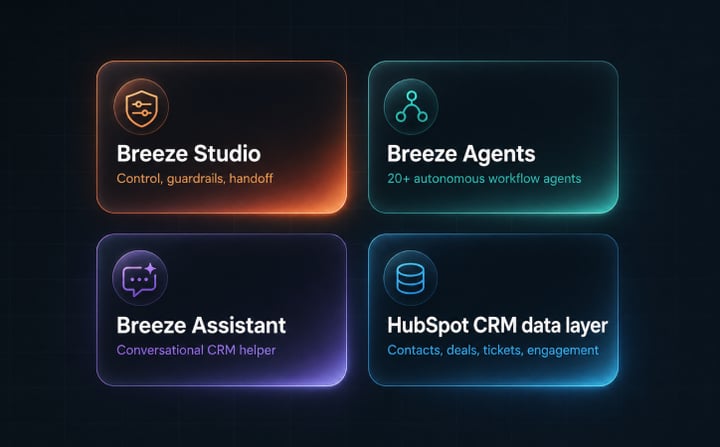
Breeze AI is HubSpot's AI layer. It is not one tool. It is a set of features built into the CRM:
- Breeze Assistant: A conversational AI helper inside HubSpot. It drafts emails, summarises records, answers questions about your CRM data, and helps you build reports and workflows.
- Breeze Agents: Autonomous AI teammates that run full workflows. The core agents handle customer support, prospecting, and data enrichment. Marketplace agents cover content, social posts, customer health, deal loss analysis, and more. As of early 2026, the Breeze marketplace supports over 20 agents and assistants.
- Data enrichment and buyer intent: Breeze pulls from a database of more than 200 million company and contact profiles to fill gaps in your CRM: industry, company size, revenue, and contact details. Standard field enrichment became free in 2026.
- Breeze Studio: The control center where you customize agent behavior, upload knowledge sources, set guardrails, and decide when an agent hands off to a human.
Compare that list with a typical B2B marketing stack. Many teams pay separately for an AI writing tool, an AI chatbot, a data enrichment platform, a social scheduling tool with AI features, and a prospecting tool. Breeze has all five categories under one roof.
The Case for Replacing Standalone Tools
1. Breeze works on your data, not just prompts
This is the single biggest difference. A standalone AI writing tool knows what you type into it. Breeze knows your contacts, deals, tickets, emails, page visits, and lifecycle stages.
That context changes the output. When the Prospecting Agent drafts outreach, it can reference the lead's company, recent activity, and deal history. When the Customer Agent answers a support question, it pulls from your knowledge base and the customer's actual record. A standalone tool can only guess, or it needs you to paste that context in manually every time.
So, for personalization at scale, connected data beats a better model with no context. You can learn more about how to prepare your HubSpot CRM data for AI Automation from here.
2. Fewer tools mean fewer integration problems
Every standalone tool needs a connection back to your CRM. Someone has to build it, map the fields, and maintain it when either side ships an update. Each connection is a place where data breaks, duplicates, or goes stale.
Breeze needs none of that. The output of one agent becomes input for the next workflow without a sync job in between. If your team already spends time fixing broken syncs, that alone is a strong argument. And if you do need external systems connected, do it deliberately through proper HubSpot integrations, not through a pile of point tools.
3. The economics have improved
Breeze moved to outcome-based pricing for its flagship agents in April 2026. The Customer Agent now costs $0.50 per resolved conversation, and you only pay when the AI actually resolves the ticket. The Prospecting Agent costs $1 per recommended lead. Other agents run on HubSpot Credits, a shared pool you can cap to avoid surprise bills.
Compare that with the standalone route: an AI writing tool at $20 to $80 per user per month, a support chatbot at roughly $1 per resolution, an enrichment platform starting in the hundreds per month. Three or four of those subscriptions often cost more than the Breeze usage of a mid-sized team, and none of them share data with each other.
One caveat: Breeze Agents require Professional or Enterprise subscriptions, and specific agents need specific Hubs. The Customer Agent needs Service Hub, and the Prospecting Agent needs Sales Hub. If you are on Starter, factor an upgrade into the math. Our HubSpot pricing overview helps you plan that.
4. Governance is built in
Audit analyzer feature, introduced in January 2026, creates a timestamped record of every agent action: which CRM properties changed, what data informed the decision, and what the agent did. For companies in regulated industries, that trail matters. Most standalone tools give you nothing comparable, and stitching audit trails across five vendors is close to impossible
Where Standalone Tools Still Win
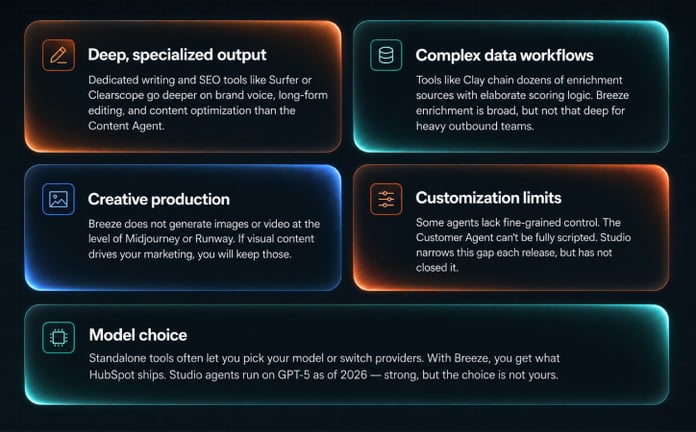
Being honest about the limits matters more than the sales pitch. There are four areas where standalone tools keep an edge.
- Deep, specialized output: Dedicated AI writing platforms offer finer brand voice control, longer-form editorial workflows, and stronger editing features than the Content Agent. SEO tools like Surfer or Clearscope go deeper on content optimization than other tools. If content is your core growth engine and quality is your differentiator, a specialist tool may still earn its subscription alongside Content Hub.
- Complex outbound and data workflows: Tools like Clay let you chain dozens of enrichment sources and build elaborate scoring logic. Breeze enrichment is broad but not that deep. Heavy outbound teams with sophisticated waterfall enrichment will notice the gap. Here’s a guide on integrating HubSpot + Clay to auto-enrich contacts without breaking things.
- Creative production: Breeze does not generate images or video at the level of Midjourney, Runway, or similar tools. If visual content drives your marketing, you will keep those.
- Customization limits: Some Breeze agents still lack fine-grained instruction control. The Customer Agent, for example, does not let you fully script how it asks questions or which offers it promotes. Standalone chatbot platforms give you more knobs to turn. Breeze Studio narrows this gap with each release, but it has not closed it.
- Model choice: Standalone tools often let you pick your model or switch providers. With Breeze, you get what HubSpot ships. Studio agents run on GPT-5 as of 2026, which is strong, but the choice is not yours.
A Simple Decision Framework
Ask three questions for every standalone AI tool you pay for:
1. Does its value come from context or from craft?
If the tool's value depends on knowing your customers (personalization, scoring, routing, support), Breeze will likely do it better because it sits on your CRM data. If the value is pure craft (long-form editorial, design, video), the specialist probably stays.
2. How much does the integration cost you?
Count the real cost: the sync tool, the maintenance hours, the data errors. If a standalone tool needs constant plumbing to stay useful, that is a hidden tax Breeze does not charge.
3. Is your CRM ready to feed it?
This is the question most teams skip. Breeze is only as good as the data underneath it. Duplicate contacts, inconsistent properties, and unclear lifecycle stages will make any AI agent worse, not better. If your portal has years of accumulated mess, start with a HubSpot portal audit before you switch anything on.
What This Looks Like in Practice
For most mid-sized B2B companies we work with, the realistic outcome is not full replacement. It is consolidation.
Breeze replaces the generic AI writing subscriptions, the basic chatbot, the entry-level enrichment tool, and the manual prospect research. One or two specialist tools survive because they do something Breeze cannot. The stack shrinks from eight AI tools to three, the data stays in one system, and the monthly bill drops.
A typical sequence looks like this.
- Month one: clean the data and clarify lifecycle stages.
- Month two: switch on Breeze Assistant for the whole team and deploy one agent, usually the Data Agent, on a small segment.
- Month three: measure results, review Audit Cards, then expand to a customer-facing agent.
- By month four, you know exactly which standalone subscriptions you can cancel and which ones you keep.
This works best when Breeze sits inside a connected system: Marketing Hub for campaigns, Data Hub for unified customer data, and clear handoffs between marketing, sales, and service.
The teams that get this wrong usually make one of two mistakes. They switch on every agent at once with no guardrails, or they deploy AI on top of a messy CRM and automate the chaos faster. The teams that get it right start with one agent on one high-value workflow, set credit limits, review Audit Cards weekly, and expand from there.
The Bottom Line
Can Breeze AI replace standalone AI marketing tools? For context-driven work like personalization, support, prospecting, and enrichment: yes, and often with better results, because it runs on your actual customer data. For craft-driven work like advanced content, creative production, and complex outbound: not yet.
The bigger point is this. Breeze is not a tool decision. It is a system decision. AI agents amplify whatever system they sit on. A clean CRM with clear processes gets faster and smarter. A messy one gets messier, just quicker.
If you want Breeze to actually replace tools instead of adding another layer of noise, start with the foundation. Buldok Marketing helps B2B companies do exactly
that through Breeze AI deployment service: audit the data, define the guardrails, pick the right first agent, and roll it out with measurable outcomes.
Not sure where your revenue system stands today? Take the Buldok GTM Score. It takes about seven minutes and shows you where to start.
.jpg)
